


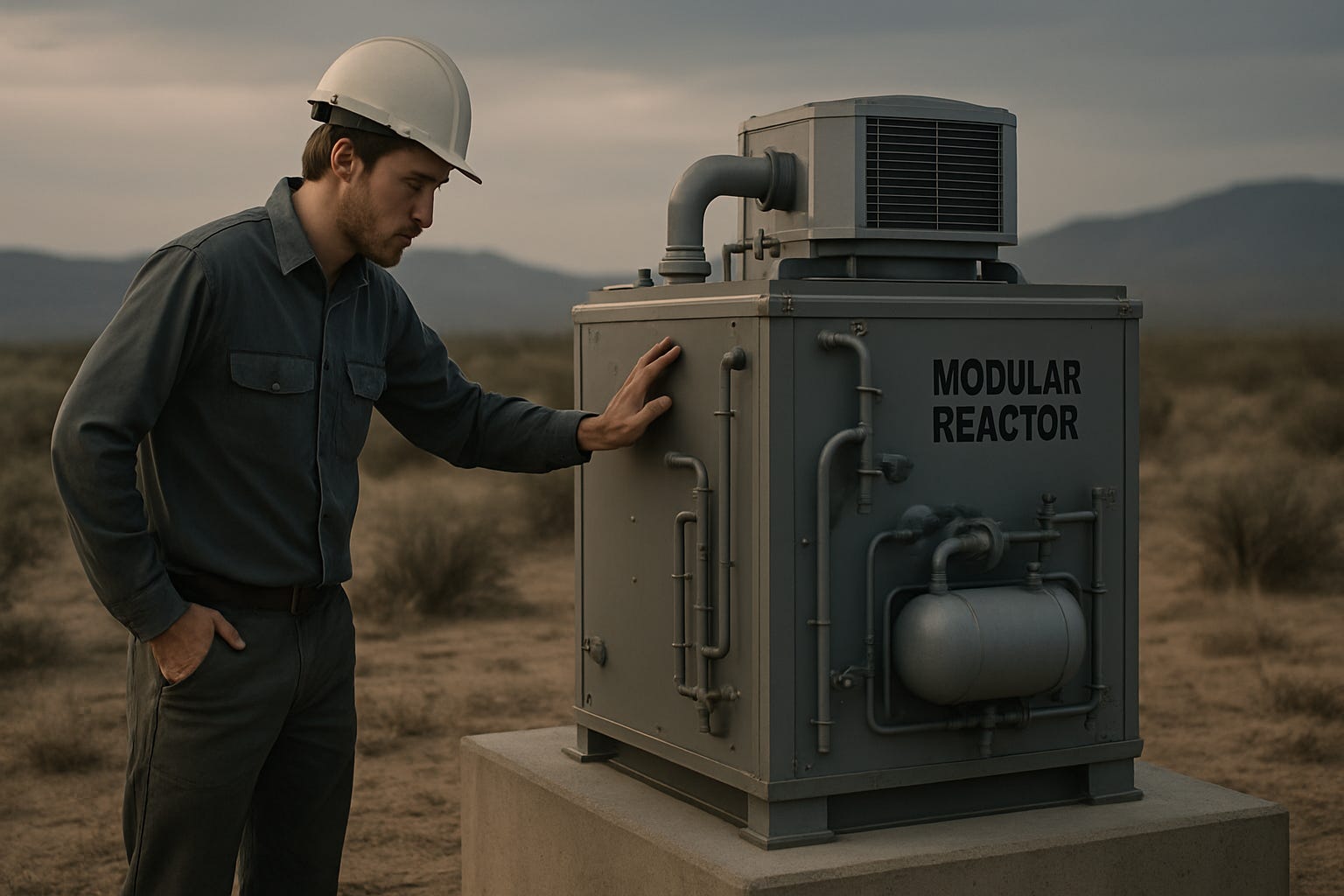
For most of nuclear energy’s history, building a reactor meant finding a river first. That was the deal: you need massive amounts of water to cool the core, so you park the plant next to a lake, a river, or an ocean, and you pump millions of gallons through the system every day. The Union of Concerned Scientists puts it plainly — nuclear plants sit on shorelines “not for the scenic views,” but because they need bodies of water to absorb the waste heat they constantly generate. For every three units of energy a conventional reactor produces, two are discharged to the environment as waste heat. That’s an enormous amount of thermal baggage to manage, and you need a river to do it.
The problem is that rivers are fickle. In the summer of 2022, France learned this the hard way when drought and record heat pushed river temperatures so high that its nuclear plants had to cut output or shut down entirely. That summer was Europe’s driest in 500 years, and by August, as many as 32 of France’s 56 reactors were offline. France — a country that normally exports electricity to its neighbors — found itself importing more power than it shipped out. A 2023 French Court of Auditors report concluded that such shutdowns could become three to four times more frequent by 2050. Climate change is systematically attacking one of nuclear power’s core assumptions.
Small modular reactors are being designed to break that assumption entirely. The physics and engineering behind modern SMR designs are genuinely different from the reactors of the 1960s, 1970s, and 1980s. Some don’t need rivers at all. Some can operate in deserts. And the reasons why matter enormously for where clean power can actually go in the coming decades.
Why old nuclear plants are so thirsty in the first place
Traditional nuclear plants use water in two distinct roles. The first is as a coolant and moderator inside the reactor vessel itself, where water slows down neutrons to the speed needed to sustain fission. The second is in the condenser, where the steam that spun the turbine gets cooled back into water so it can cycle through the system again.
It’s that second step — the condensing — that demands so much water. As the Breakthrough Institute explains, older coastal plants typically used “once-through” cooling: seawater flows in through filters, passes through tubes in the condenser, and gets pumped back out into the ocean slightly warmer. A large reactor required staggering flow rates. According to historical research published via Project MUSE, the small 581 MWe Ginna plant in New York needed 6,000 gallons of water per second, while the two reactors at Calvert Cliffs in Maryland required 20,000 gallons per second each. The two reactors at South Africa’s Koeberg station pulled 40 cubic meters of seawater per second from the Atlantic.
That’s why, as the MUSE researchers note, virtually all large nuclear plants ended up on coastlines or riversides. It wasn’t a design preference. It was a physical necessity. You either had access to a giant, continuous water source, or you didn’t build.
The World Nuclear Association documents how this water dependence created real operational vulnerabilities, not just theoretical ones:
In mid-2010, the Tennessee Valley Authority cut output at three Browns Ferry reactors in Alabama to 50% to keep river water below 32°C — at a cost of roughly $50 million to ratepayers
That same week, Rhine and Neckar river temperatures in Germany approached the critical 28°C threshold, threatening nuclear plant closures
In August 2012, Connecticut’s Millstone station shut down one unit because Long Island Sound seawater exceeded 24°C
These aren’t edge cases. They’re what happens when a technology is fundamentally coupled to environmental water conditions, and those conditions get increasingly extreme.
How SMR designs cut the water cord
The newer SMR designs attack the water problem at multiple levels, and the approaches vary quite a bit depending on whether a design uses water, molten salt, sodium, or gas as its primary coolant. 🔬
Water-cooled SMRs don’t escape the need for some water, but they’ve substantially reduced how much they need and, more importantly, where it has to come from. Many designs use passive safety systems — gravity and natural convection rather than powered pumps — which reduces the scale of cooling infrastructure required. According to energy.sustainability-directory.com, passive systems in SMRs rely on:
Natural circulation, where heated coolant rises and cooled coolant sinks without any pump
Gravity-driven water delivery from tanks positioned above the reactor core
Conduction of heat directly through the reactor vessel wall into surrounding structures or air
The NuScale Power Module, the first SMR to receive design certification from the U.S. Nuclear Regulatory Commission, was planned with dry air cooling for its Idaho deployment. No river required. The condensate cycle can close using cooling towers or air-cooled condensers rather than a natural water body — you lose a few percentage points of efficiency, but you gain the ability to put the plant wherever it makes sense economically and strategically, not wherever there happens to be a river.
Holtec’s SMR-300 is particularly explicit about this. The company has built an optional Air-Cooled Condenser (ACC) system directly into the design, which it says enables operation in “arid environments” and “water-challenged locales.” In May 2026, Holtec announced that its SMR-300 was selected for the Green River Advanced Nuclear Project in Utah — a desert state. That choice wasn’t arbitrary; the ACC system makes it viable where a conventional plant simply could not go.
Non-water coolants change the rules completely ⚡
Then there are the designs that don’t use water as their primary coolant at all, and these are the ones that really scramble conventional nuclear geography.
TerraPower’s Natrium reactor, now under construction at Kemmerer, Wyoming under a construction permit issued by the NRC in March 2026, uses liquid sodium as its primary coolant rather than water. As Wyoming Public Media reported, sodium cooling is safer than traditional water cooling “compared to the traditional nuclear plant cooling method of water that requires much higher pressure.” Sodium carries heat at much lower pressures, which dramatically simplifies the primary circuit. Kemmerer sits in the high desert of southwest Wyoming, far from any major water body — and that’s entirely fine for a sodium-cooled reactor. The U.S. Department of Energy confirmed the NRC’s December 2025 safety review came in ahead of schedule and 11% under budget. This is a real project, breaking real ground.
Molten salt reactors are even more radical. Designs like Terrestrial Energy’s Integral Molten Salt Reactor (IMSR) operate at high temperatures and low pressure, using fluoride salts that are liquid at operating temperature. According to Wikipedia’s molten-salt reactor article, the IMSR is specifically designed as a deployable SMR with high-temperature output suited to industrial heat markets beyond just electricity. When things go wrong with a molten salt reactor, the salt freezes — it’s a passive safety mechanism baked into the physics, not an engineered response. Decay heat removal in some designs uses nitrogen, with air as a backup. Not a drop of river water involved.
Gas-cooled designs like X-energy’s Xe-100 use helium as the coolant. The UN Scientific Advisory Board’s December 2025 brief on SMRs notes that these systems “offer the potential for higher thermal efficiencies and improved fuel utilization.” The Xe-100 uses TRISO fuel — essentially tiny spheres of nuclear fuel encased in multiple layers of ceramic protection. Those fuel pebbles can withstand the heat of an accident without external cooling, which means the reactor can potentially be sited, cooled, and operated with far less dependence on environmental water. 🌱
The siting freedom this actually creates
Here’s why this matters beyond engineering curiosity. The water constraint has historically shaped not just where nuclear plants were built, but who got access to nuclear power at all.
Landlocked regions, arid countries, remote industrial sites, military bases in the middle of nowhere — all of these have historically been out of the running for nuclear power because you couldn’t get enough water there. SMRs are changing that geographic calculus in concrete ways. The U.S. Energy Information Administration reported in April 2026 that the U.S. Army’s Janus Program has already selected nine military bases as potential microreactor sites, including Fort Bragg, Fort Campbell, and Fort Hood. The Air Force is planning its first microreactor at Eielson Air Force Base in Alaska, working with Oklo’s sodium-cooled Aurora design.
None of these are riverside installations in the traditional sense. The Wikipedia article on nuclear microreactors notes they can be installed underground, underwater, or in other remote locations — a 15-megawatt reactor designed to go a mile underground in a borehole, like Deep Fission’s concept, doesn’t need a cooling tower or a river at all. The Earth itself is the heat sink. 🏗️
The practical geography of SMR deployment, based on what’s actually happening in 2026, looks something like this:
Desert industrial sites — Holtec’s Utah project, using air-cooled condensers in water-scarce terrain
Retired coal plants — TerraPower’s Wyoming site, where some existing infrastructure is reused but water access is minimal
Remote military bases — Army’s Janus Program microreactors, prioritizing energy resilience over geographic convenience
Off-grid communities — Alaska, Canada, and island nations where diesel dependence is costly and water supply uncertain
The common thread: all of these locations were previously inaccessible to nuclear power. That’s a meaningful expansion of where clean, reliable, carbon-free baseload power can actually go.
Have you thought about which industries or regions stand to gain the most from nuclear power freed from water constraints? The answer might surprise you.
One honest caveat about water ♻️
It’s worth being clear that not all SMRs are water-independent, and some water-cooled SMR designs still depend on external water for their condenser loops — they’ve just reduced the volume required compared to conventional plants. The World Nuclear Association notes that the Holtec SMR-160 and B&W mPower designs “use dry cooling or can do so,” while other water-based SMR designs retain some water dependence for their steam condensers. The IAEA and UN Scientific Advisory Board are also careful to distinguish between light-water SMRs, which still use water as their primary coolant, and Advanced Modular Reactors (AMRs), which use liquid metals, gases, or molten salts.
Even among designs that still need water for their secondary loop, the requirement is far smaller than conventional plants. Passive safety systems mean the reactor can shut down safely without the emergency water flows that Fukushima’s reactor required when its cooling pumps lost power. The sheer reduction in required flow rates opens up smaller rivers, groundwater wells, or even closed-loop water systems that would have been unworkable for a 1,000 MWe conventional plant.
The broader point, though, is directional: the technology trajectory is clearly toward water independence, not away from it. Sodium, salt, helium, and air-cooled water systems all point the same direction. The question for the industry isn’t whether SMRs can eventually break free of water constraints. It’s whether they can get to commercial scale fast enough to matter — which is a different problem entirely, and one the industry is working urgently to solve.
Given that climate change is simultaneously making water-dependent nuclear plants less reliable and increasing demand for reliable zero-carbon power, that urgency seems well-placed. What’s your take on whether water independence should be a harder requirement for future nuclear licensing, rather than just a design option?