


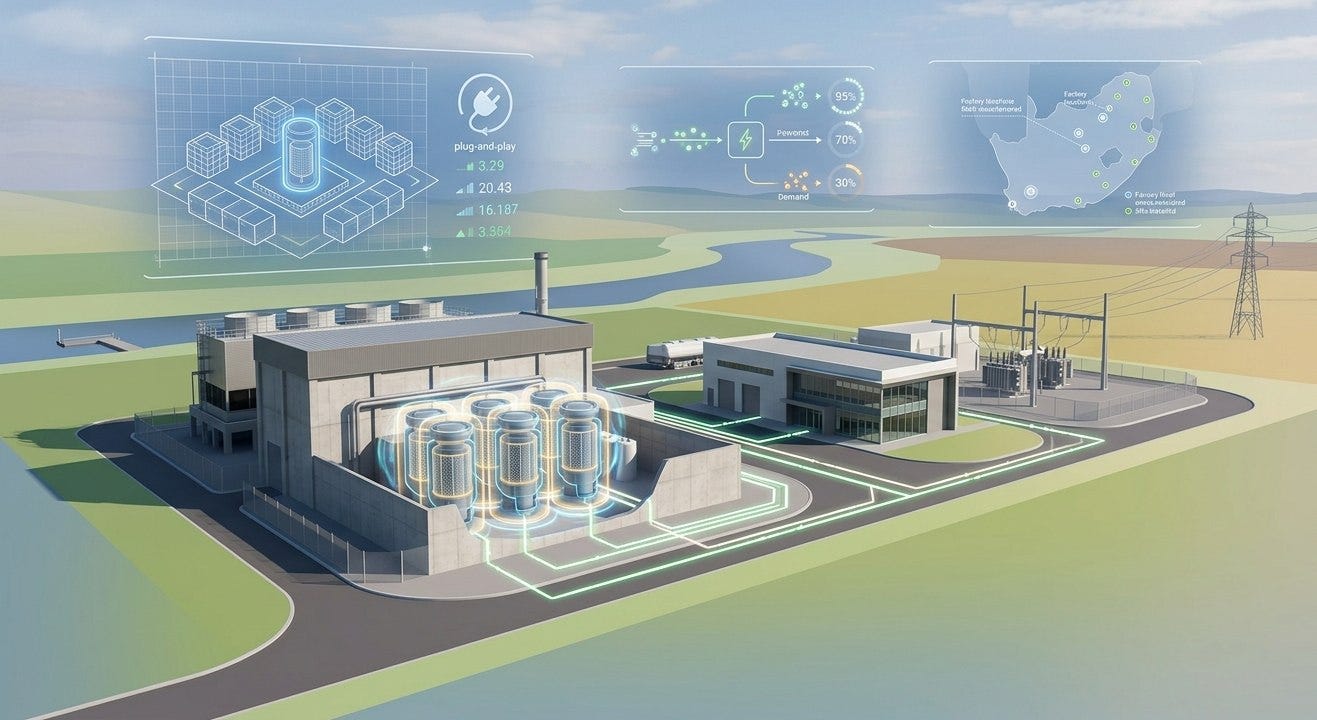
For most of the past three decades, nuclear energy was the technology that everyone agreed was important and nobody actually built. Too expensive. Too slow. Too politically toxic. Then something shifted. Suddenly, Amazon, Google, and Microsoft are racing to sign contracts with companies most people have never heard of, governments from Canada to Poland are fast-tracking approvals, and the phrase “small modular reactor” appears in tech news more often than in energy news. So what exactly is an SMR, and why is it having this particular moment?
The short answer is that an SMR is a nuclear power plant, but a smaller, factory-built version of one. The longer answer is that “smaller” is doing a lot of work in that sentence, and the “factory-built” part is where the real argument lives. Let’s get into it.
What an SMR actually is (and isn’t)
The International Atomic Energy Agency defines a small modular reactor as a nuclear reactor with a power capacity of up to 300 megawatts electric (MWe) per unit, roughly one-third the output of a traditional large nuclear plant. That “modular” part means the components can be manufactured in a factory, shipped to a site, and assembled there, rather than being custom-built on location from scratch. 🔬
Every SMR still works on the same basic physics as every other reactor. Nuclear fission heats a coolant, usually water but sometimes molten salt, liquid metal, or gas, that coolant makes steam, the steam spins a turbine, and the turbine generates electricity. The difference is scale and construction method. Traditional plants push 1,000 MWe or more per unit. An SMR might deliver 80 MWe from a single module, with customers adding modules over time as their power needs grow.
A few other things worth knowing upfront:
SMRs occupy roughly 0.01 square kilometers, compared to the 1 to 2 square kilometers needed for a conventional nuclear plant
Their passive safety systems rely on physics like natural convection, not pumps or backup generators, to cool the core if something goes wrong
They can be designed for electricity, process heat, desalination, or hydrogen production
Microreactors, a subset of SMRs, go even smaller, typically under 10 MWe, designed for remote communities or military bases
Now, some critics argue, not without merit, that “small reactor” is not actually a new idea. Small reactors powered naval submarines starting in the 1950s, and the U.S. Army ran land-based small reactors for military installations between 1954 and 1977. What’s new isn’t the concept. What’s new is the commercial model behind it. 🏭
The bet is that serial factory production of reactor modules, the same logic that made Boeing’s assembly lines cheaper than bespoke aircraft construction, will eventually drive nuclear energy costs down to levels that compete with gas and renewables. That bet remains unproven. But a lot of very serious money is now riding on it.
Where things actually stand right now
Here’s the bracing reality check that most SMR coverage buries: as of 2025, only China and Russia operate functional commercial SMRs. Russia’s Akademik Lomonosov, a floating nuclear power plant with two KLT-40S reactors, has been producing electricity in the Arctic city of Pevek since 2020. China’s HTR-PM pebble-bed reactor connected to the grid in 2021. That’s it. The entire Western world has zero operating commercial SMRs. ⚡
The pipeline, though, is genuinely enormous. According to the IAEA, there are now more than 127 SMR designs at various stages of development globally, with seven designs either operating or under construction. In the United States, the situation is:
NuScale Power’s VOYGR is the only SMR design fully licensed by the Nuclear Regulatory Commission
The Department of Energy selected 11 companies in 2025 to build and operate test reactors, with a target of achieving criticality in at least three by mid-2026
The DOE awarded $400 million each to Tennessee Valley Authority and Holtec in December 2025 to support early SMR deployment
President Trump signed four executive orders in May 2025 to accelerate SMR licensing and permitting
Canada made arguably the biggest concrete move of 2025: a final investment decision to build a BWRX-300 SMR at the Darlington site, with a projected cost of CA$7.7 billion for the first unit and CA$13.2 billion for three additional units. That’s real money committed to real ground, which is more than most Western SMR projects can claim. 🌍
In Europe, the European Commission launched an SMR Industrial Alliance in February 2024 and published an acceleration strategy in March 2026. Projections from the EU’s 8th Nuclear Illustrative Programme suggest the bloc could reach between 17 GW and 53 GW of SMR capacity by 2050.
Think about where you would want the first SMR in your country built. That question is going to become very real, very fast.
Why Big Tech is writing the checks
The AI boom is doing more for nuclear energy than twenty years of climate policy managed to accomplish. The reason is simple and uncomfortable: AI data centers are extraordinarily hungry for electricity, and that electricity needs to be available 24 hours a day, 365 days a year, regardless of cloud cover or wind speed. Solar and wind, for all their progress, cannot guarantee that.
The numbers from the Information Technology and Innovation Foundation make the scale of the problem clear. AI data centers are projected to consume 945 terawatt-hours annually by 2030, roughly equivalent to Japan’s entire national electricity consumption. The global pipeline of SMR projects hit 47 gigawatts in early 2025, with more than half of that capacity in the United States.
Here’s how the tech giants have positioned themselves:
Google signed a 500 MW deal with Kairos Power in October 2024, the first corporate SMR fleet agreement in the U.S., with the first reactor targeting 2030. In May 2025, Google doubled down with early-stage capital to Elementl Power for three additional U.S. sites totaling 1.8 GW ☢️
Amazon led a $500 million financing round for X-energy, backing 5 GW of SMR projects by 2039, while also securing agreements with Energy Northwest and Dominion Energy
Oracle announced plans to build a gigawatt-scale data center powered by three SMRs, with CEO Larry Ellison stating building permits were already secured
Meta issued a request for proposals seeking 1 to 4 GW of new nuclear generation for data centers in the early 2030s
Microsoft, meanwhile, went a different route, restarting Three Mile Island’s Unit 1 through a 20-year deal with Constellation Energy, targeting 835 MW online by 2028
It’s worth noting what the Georgetown Journal of International Affairs pointed out bluntly: many of these tech deals are investments in speculative, as-yet-unbuilt technology. The distinction between Microsoft betting on a proven, restarted reactor and Amazon betting on SMR designs that have never operated commercially is significant, and not enough coverage makes it. 💡
The honest case for and against
No honest article about SMRs ends with pure enthusiasm, because the technology’s promise and its problems live very close together.
The case for SMRs, stated plainly:
Factory production can achieve economies of scale that on-site nuclear construction never could, similar to how the aerospace industry produces planes at decreasing unit cost
Siting flexibility means SMRs can go where large plants cannot, remote communities, retired coal sites, industrial clusters, military bases
They offer firm, always-on, zero-carbon electricity, something neither wind nor solar can promise without storage
The World Nuclear Association notes that SMRs have a significantly lower upfront capital cost per unit, reducing financial risk for investors and owners
The case against, equally stated:
First-of-a-kind costs are high and may stay high. The ITIF report from April 2025 flags that SMRs will probably cost as much per kilowatt as large reactors, or more, until serious production scale is achieved
Nuclear waste from SMRs is real and unresolved. The U.S. still has no functioning long-term disposal repository, and advanced SMR designs may complicate the waste picture further ♻️
Construction timelines remain uncertain. Most Western SMR projects won’t be online until the 2030s at the earliest
Proliferation risks increase when fuel enrichment levels rise and when reactor modules are transported across international borders
The ITIF’s framework of price and performance parity, getting SMR costs down to where they genuinely compete without subsidies, is the right lens for evaluating any specific project. Right now, most SMR economics depend on government grants, favorable loan terms, or premium-priced power purchase agreements from tech giants willing to pay extra for reliable, clean power. That’s not a fatal flaw. Every energy technology starts with subsidies. But it does mean the clock is ticking on proving the economics at scale.
What makes this moment different from all the other “nuclear comeback” moments
Nuclear’s story is littered with announced comebacks that quietly died. The 2000s had a “nuclear renaissance” that produced almost nothing. So why should this moment be any different?
A few things genuinely are different this time:
The customer has changed. When utilities were the only buyers, nuclear’s long construction timelines and uncertain costs were poison. Tech companies signing 20-year power purchase agreements at premium rates change the financing calculus completely. A guaranteed customer willing to pay a premium for carbon-free, always-on power makes an SMR project bankable in ways it wasn’t before.
Regulatory momentum is real. The U.S. ADVANCE Act of 2024 streamlined NRC licensing. Four Trump executive orders in May 2025 pushed further. The EU published an SMR strategy in March 2026. This is not countries talking about regulatory reform, it’s countries doing it.
The geopolitical urgency is new. Russia and China both have operating SMRs and are offering them to developing nations as package deals, complete with financing and fuel supply. The ITIF’s April 2025 report argues explicitly that SMRs could become a strategic export industry for the U.S., and competing against state-backed Russian and Chinese designs requires domestic deployment to happen, not just designs on paper. 🚀
Private capital is showing up. Oklo’s stock rose over 500% in 2025. NuScale, which has never built a reactor and lost $348 million last year, carries a market cap of roughly $11.3 billion. These valuations are speculative, sure. But capital at that scale, flowing toward companies with nothing yet built, is a signal that investors believe something is coming.
Rolls-Royce’s SMR program projects its 470 MWe reactor, bigger than IAEA’s strict SMR definition but designed with the same factory model, will generate £52 billion in economic benefit for the UK and create 40,000 jobs by 2050. Memoranda of understanding are already in place with Estonia, Turkey, and the Czech Republic. That’s not vaporware. That’s a supply chain being assembled.
The honest summary: SMRs are not a solved problem. But they are, for the first time in a long time, a problem with real money, real regulatory momentum, and real commercial customers behind them. That combination hasn’t existed before.
What would it take for you to change your mind about nuclear energy? And if you already believe in it, what’s the one barrier you think is hardest to crack?