


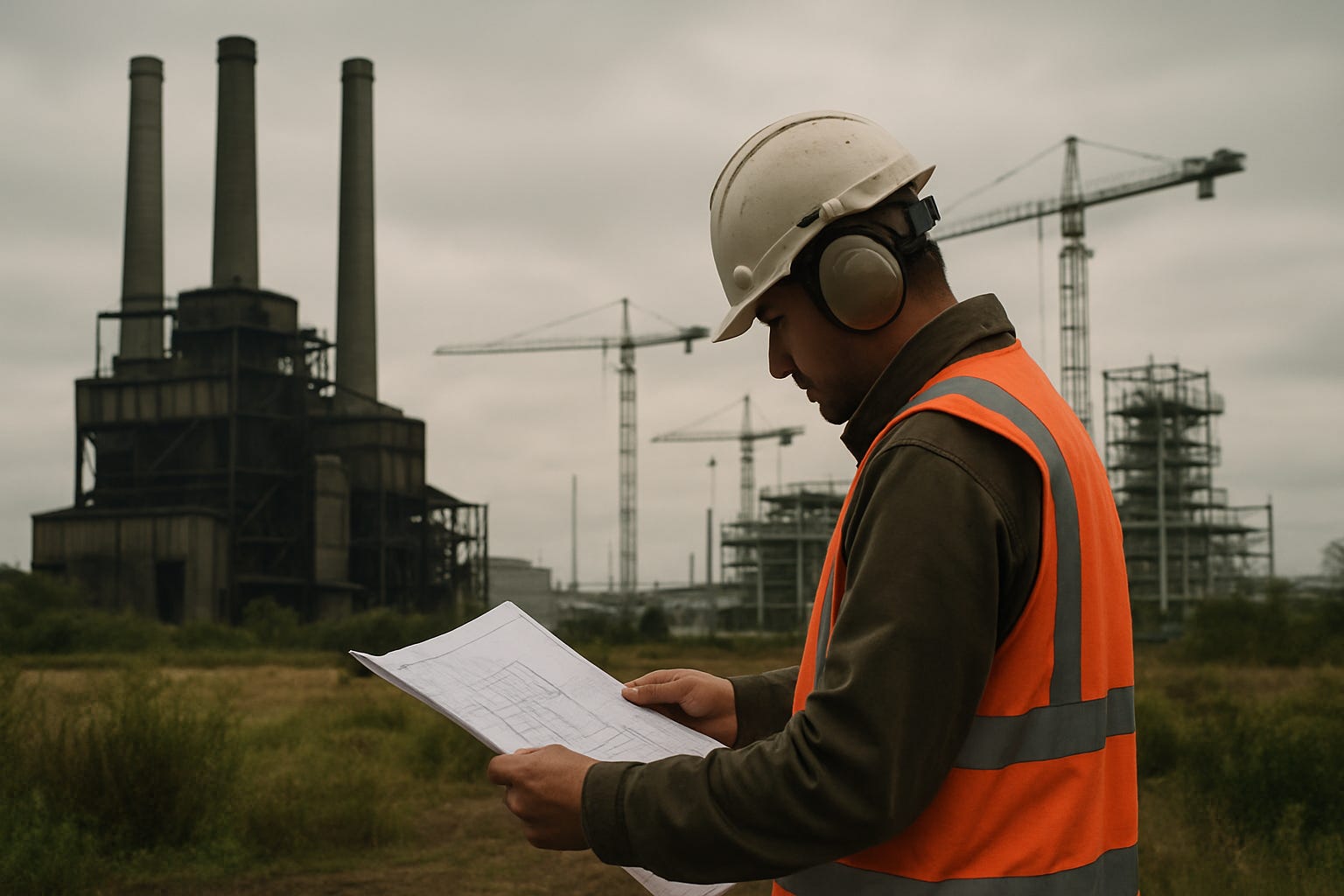
Kemmerer, Wyoming, population 2,500, has been through this before. The Naughton coal-fired power plant opened in the 1960s and became the town’s spine — jobs, tax base, identity. Then ExxonMobil’s gas plant arrived in the mid-1980s. Then the gas and oil booms. Then the busts. Kemmerer knows the boom-and-bust rhythm so well it might as well be in the town charter. So when TerraPower, the nuclear company backed by Bill Gates, announced in 2021 that Kemmerer was its pick for the Natrium advanced reactor — a $4 billion sodium-cooled demonstration plant right next to the retiring Naughton plant — the reaction was not quite jubilation. It was something closer to cautious, weather-beaten hope.
“It’s given us all hope. A lot of hope,” said Phillip Viviano, owner of Rosie’s Pizzeria and Sports Bar, to WyoFile in early 2025. He added that you could see the community go from yellow lawns to green lawns, to people painting houses and putting new roofs on. That’s the power of anticipation in a small town. One announcement, and the whole place exhales. But Kemmerer is also the perfect stress test for the question that matters most as coal communities face closure after closure: when an SMR actually moves in, what changes, what doesn’t, and who gets left behind?
The infrastructure inheritance that nobody talks about
Here is something the energy transition narrative almost always skips: coal plants are expensive to build, and much of what they built can be reused. Transmission lines, cooling water intakes, electrical switchyards, administrative buildings, access roads — all of it has value. A 2024 analysis by the Bipartisan Policy Center found that reusing coal plant infrastructure can cut SMR construction costs by 17% to 35%. That’s not rounding-error savings. On a $4 billion project, that’s potentially $1.4 billion back in the budget. 🏗️
The U.S. Department of Energy estimates there are opportunities to add up to 174 gigawatts of new nuclear capacity at retiring coal plant sites across the country. Eighty percent of evaluated coal plants already have the basic physical characteristics needed for repowering. That figure matters because it means the coal-to-nuclear argument isn’t just political theatre — it’s a genuine economic case built on sunk infrastructure costs.
What specifically transfers to the new plant:
Steam turbines and generator equipment (often compatible with nuclear steam sources)
High-voltage transmission infrastructure and grid connections
Cooling water systems and intake permits
Site permits, environmental studies, and community approvals already completed
Skilled workers who understand high-temperature, high-pressure plant operations
The World Economic Forum’s 2024 nuclear framework makes the point plainly: SMRs can slot into coal plant footprints without requiring a total overhaul of the local economy. That “slot in” language is probably a little optimistic, but the core physics of it is right. You are not building from nothing. You are converting. And that distinction makes a massive difference to the timeline, the budget, and the community.
The job math: more numbers, harder questions
The job creation case for coal-to-nuclear sounds great on paper. A 2022 DOE study — updated by an information guide in 2024 — found that replacing a coal plant with a comparably sized nuclear plant generally increases long-term jobs, local income, and local revenues. The same study found that employment in the region could increase by more than 650 permanent jobs spread across the plant, supply chain, and surrounding community, with additional annual economic activity of $275 million. 💼
TerraPower’s Natrium project in Kemmerer specifically promises:
1,600 construction jobs at peak building activity
250 permanent operating jobs when the plant goes online around 2030
40 additional permanent jobs at the nuclear training facility
Indirect job growth in services, housing, and retail throughout the construction period
Romania’s Doicesti project — a former coal plant site about 90 kilometers northwest of Bucharest where NuScale’s technology is being deployed — tells a similar story. The Final Investment Decision taken in early 2026 estimates nearly 200 permanent jobs, 1,500 construction jobs, and 2,300 manufacturing and component assembly jobs over the plant’s 60-year life.
Those numbers look good. But ask the coal miner eating dinner at Rosie’s Pizzeria and you’ll hear the other side. “They’re going to bring their own people — I mean, it’s a nuclear plant. You don’t just go from running earth-moving machinery to running a nuclear plant.” He has a point. The DOE’s own information guide concedes that while most coal plant roles have “direct or similar matches” at nuclear plants, reskilling is required. It isn’t automatic. And reskilling takes time that displaced miners don’t always have. 🔧
The IEA’s 2025 World Energy Employment report adds a broader warning: nuclear and grid-related professions face some of the steepest demographic challenges in the entire energy sector, with retirements outnumbering new entrants by 1.7 to 1. The industry needs people. But it needs trained people, and the training takes years. Are you curious whether your community could realistically bridge that gap in time? That answer depends heavily on how early the retraining programs start — Western Wyoming College’s new nuclear degree program, launched in anticipation of Natrium, is exactly the kind of early-mover action that makes the difference.
The boom problem nobody likes to talk about
Small towns are not designed for sudden population surges. This is maybe the least-discussed consequence of a major energy project arriving in a community of 2,500 people, and it’s genuinely complicated to manage. 🏘️
At peak Natrium construction, Kemmerer expects between 1,200 and 1,600 workers to arrive. That’s roughly doubling the town’s population. The city administrator, Brian Muir, has said directly that while he’s grateful for the growth, it’s also an enormous stress. The town needs approximately $10 million in road repairs. The wastewater treatment plant needs at least $45 million in upgrades. Then, in 2025, Wyoming’s state legislature slashed property taxes, carving tens of thousands of dollars out of the town’s operating budget right when the demand for services is about to explode.
Then there’s the bust problem on the back end. As Kemmerer businessman Seth Snyder told WyoFile: “We know we’re going to see a large amount of people come in. We have to hire more cops to patrol our streets. Then we’re going to plateau and people are going to leave once construction is done. Now we have to fire cops. So it’s a really difficult situation to be in.”
The challenges stack up fast:
Housing prices surge before workers even arrive, pricing out long-term residents
Service businesses cannot find enough staff to handle current demand, let alone the construction wave
Infrastructure gaps in water, sewer, and roads need expensive fixes before the economic benefit materializes
State revenue cuts arrive at the worst possible moment, shrinking municipal budgets right when they need to grow
This is not unique to Kemmerer. Any coal town receiving a large industrial project faces the same paradox: you need to spend money you don’t yet have, on infrastructure for people who aren’t there yet, to support an economy that won’t pay off for five to ten years. The communities that navigate this best are the ones that plan early, pursue federal infrastructure grants aggressively, and phase housing construction ahead of worker arrivals rather than scrambling to catch up.
What the real transition gap looks like
The distance between “coal town” and “nuclear town” is not just measured in years of construction. It’s measured in skill certifications, community college curricula, and the willingness of mid-career miners to go back to school. 📚
The DOE’s Coal-to-Nuclear Transitions information guide is honest about this. It flags an “operations gap” — the period between when a coal plant closes and when the nuclear replacement comes online, which can stretch several years. During that gap, tax revenue drops, some workers leave for other regions, and the community’s economic base thins out precisely when it needs to stay stable.
At Kemmerer, the coal mine laid off 28 workers in March 2025 and shifted from three shifts to two, ending 24-hour operations. The Naughton plant itself fully converted to natural gas at the end of 2025, putting related coal jobs in question. TerraPower won’t be operational until around 2030. That’s five years of transition pressure on a community of 2,500, with some workers eligible for nuclear retraining and others — particularly older miners — facing a harder math.
What makes the retraining case realistic rather than wishful:
Most coal plant operators already work with high-pressure steam, complex process control, and emergency shutdown systems — the core skill set of nuclear operations
Trade apprenticeships in pipefitting, electrical work, and instrumentation transfer directly
The IEA estimates that half of workers displaced from fossil fuel sectors have skills applicable to clean energy with targeted on-the-job training
DOE’s 2025 Energy Workforce Advisory Board formally recommended pilot programs to accelerate the coal-to-nuclear pipeline, citing nuclear’s severe shortage of qualified operators
The CSIS analysis of global workforce transitions offers a sobering counterpoint from Poland, where an 80% reduction in coal jobs since the 1990s was accompanied by retraining programs that ultimately failed to place most workers in new jobs. The difference in Kemmerer — the one that might make it work — is that the replacement employer is arriving before the coal jobs fully disappear, not years after. That sequencing is rare. When it works, it’s the difference between a managed transition and a ghost town.
The broader template: why Kemmerer matters beyond Wyoming
Kemmerer is a test case, and the nuclear industry knows it. 🌐 If Natrium comes online on schedule in 2030, if the local retraining programs produce qualified operators, if the housing boom doesn’t price out long-term residents and the infrastructure upgrades get funded — Kemmerer becomes the proof of concept that the coal-to-nuclear story can actually be told.
Nearly a quarter of the current U.S. coal-fired fleet is scheduled to retire by 2029. That’s hundreds of communities facing the same version of Kemmerer’s question. In Romania, the Doicesti project is making the same argument for Central Europe’s coal belt. In Poland, GE Hitachi’s BWRX-300 is advancing with a coal replacement mandate embedded in the plan. The Rolls-Royce SMR programme targets 40,000 regional UK jobs and £52 billion in economic benefit by 2050, with explicit prioritization of retired coal and gas plant sites. A University of Texas at Austin study published in October 2024 projected that an SMR industry in Texas alone could employ an annual average of 148,000 people over 26 years, generating $50.6 billion in new economic output.
These numbers exist because someone had to go first. Kemmerer, Wyoming — a town of 2,500 people that refused to go quietly — is that first. Whether it becomes a model or a cautionary tale depends on decisions being made right now: about infrastructure funding, retraining program timing, housing policy, and whether state and federal governments treat the transition gap as a problem to solve or a budget line to cut.
What’s your read — does the coal-to-nuclear story depend on getting the workforce transition right first, or is the infrastructure argument strong enough to carry the economics even without a perfect skills match?