


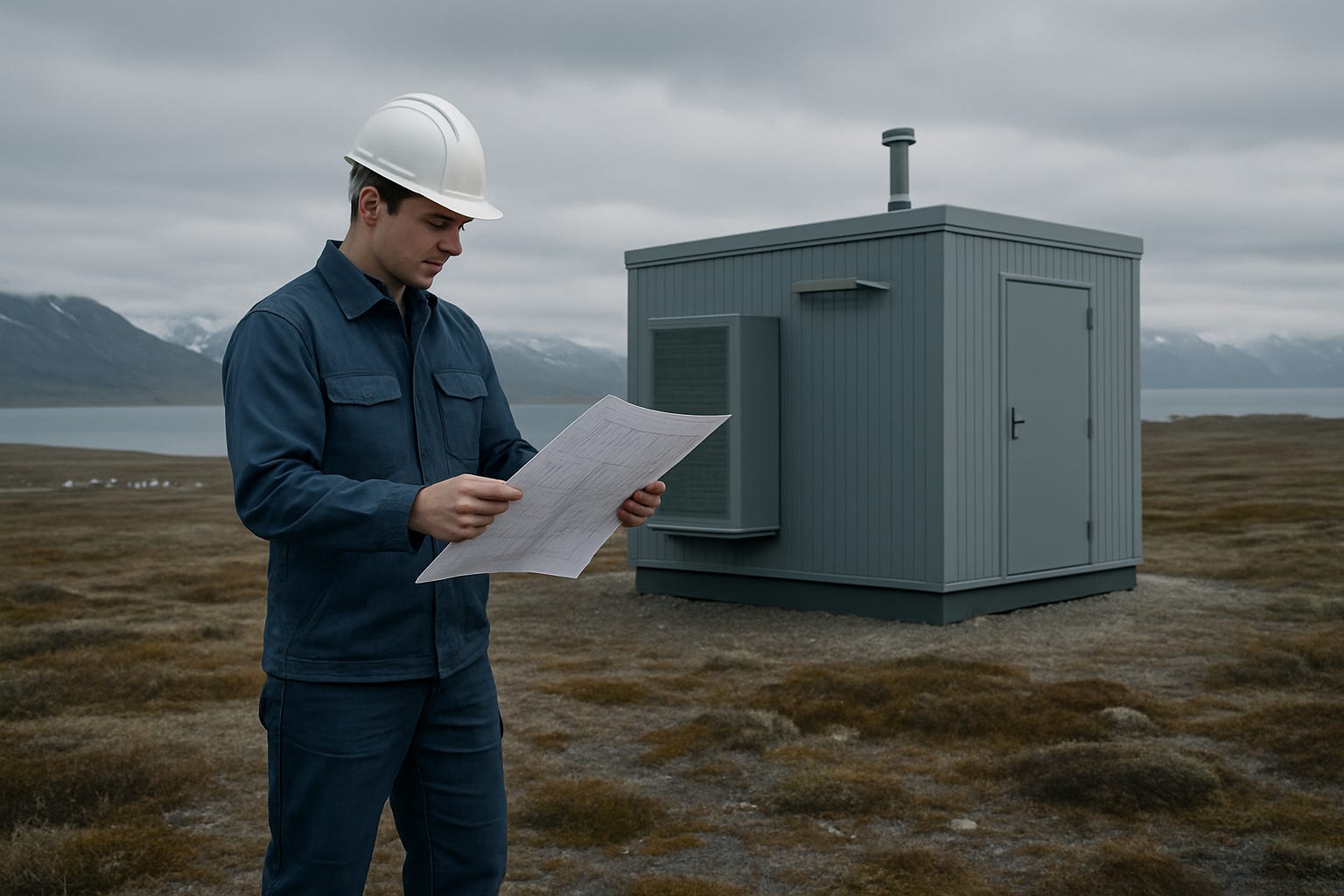
Picture the hamlet of Ambler, Alaska. No roads connect it to anywhere. Summer barges bring in supplies — including the diesel fuel that powers everything from the lights to the water treatment plant. When the barge window closes, the fuel that didn’t arrive doesn’t arrive until next year. In August 2023, diesel prices in communities like Ambler and Kobuk exceeded $15 per gallon, according to reporting by the Alaska Beacon. Electricity in some of these villages costs more than $1 per kilowatt-hour, compared to the U.S. national average of roughly 12 cents. The villagers aren’t getting ripped off. They’re simply paying the true cost of moving fuel to places that physics and geography conspire to make brutally difficult to reach.
This is the diesel trap. And it’s not a small problem. In Canada alone, over 300 remote communities depend on diesel generators, many of them accessible only by ice road or air. Nearly 200 remote Alaskan communities run almost entirely on diesel power. The Canadian federal government has poured C$443 million into its Clean Energy for Rural and Remote Communities program since 2018, trying to chip away at a dependency that, if anything, has grown more expensive and more complicated to sustain. Solar helps in summer. Wind helps when it blows. But neither solar panels nor wind turbines can carry an Arctic village through four months of polar darkness and minus-40-degree temperatures on their own.
Which is where a genuinely strange idea enters the conversation: what if nuclear power, in miniaturized form, is actually the most practical solution for places where practicality is everything?
The diesel problem is bigger than the fuel bill 🔋
It’s tempting to frame the remote diesel problem as purely economic — and the numbers are bad enough on their own. A northern Ontario household, according to Pembina Institute analysis, pays more than $3,000 per year in energy costs, more than twice the national average. Some Yukon households hit $4,500. In Alaska, energy bills run 33% higher than the national average even before accounting for the most isolated communities.
But the cost is only part of the misery. Consider what else comes with diesel dependence:
Fuel spills: Every delivery, every storage tank, every aging generator line is a potential contamination event in ecosystems that are already under pressure from warming temperatures
Supply chain fragility: A bad ice year, a barge breakdown, or a geopolitical shock in global oil markets sends ripples straight to communities that have no alternative
Noise and air quality: Diesel generators run constantly, often poorly maintained, pumping fumes into villages that are frequently small and enclosed
Aging infrastructure: Kathairos notes that “most diesel generators in operation are aging,” creating a ticking maintenance clock for communities that can’t easily source parts or technicians
The U.S. Department of Energy confirmed that there are hundreds of isolated U.S. communities, primarily in Alaska and island territories, with microgrid power systems ranging from 200 kilowatts to 5 megawatts, and that the cost of electricity is “sometimes more than $1/kWh” — varying directly with the price of oil. These aren’t edge cases. They’re the normal reality for hundreds of thousands of people, many of them Indigenous, who have simply never had access to reliable, affordable power.
Does this sound like a situation that a few more solar panels might fix? Or does it sound like a problem that needs a fundamentally different kind of energy source?
What microreactors actually offer ⚡
The nuclear industry has spent years being loudly uninterested in small-scale power. The economics of traditional reactors favor gigawatts, not megawatts — you build big to spread the fixed costs. But microreactors are a genuinely different category. These are nuclear reactors producing roughly 1 to 20 megawatts of electricity, factory-assembled, and designed to be transported by truck, rail, or ship in a single unit.
Two things make them relevant to remote communities in particular:
Long refueling cycles: The Idaho National Laboratory explains that next-generation microreactors are designed to operate years without refueling, in the same way nuclear submarines run for years on a single fuel load. Westinghouse’s eVinci microreactor, for instance, is designed to produce 5 MW for eight years between refuelings. Compare that to diesel, which needs daily replenishment.
Passive safety: Unlike earlier reactor generations, microreactor designs use gravity and natural convection for cooling rather than active pump systems. The DOE defines a microreactor as a system that, by design, “uses passive safety systems to avoid overheating or a meltdown” without needing a large workforce of specialized operators. That’s important in communities where finding qualified diesel mechanics is already a challenge.
According to ScienceDirect analysis, microreactors become cost-competitive with diesel generators when diesel fuel costs exceed $1.50 per liter — a threshold that is already routinely surpassed in Alaska’s most remote communities. The same analysis found that microreactors are “significantly cheaper than a 100% renewable and battery system” in these contexts. The Nuclear Energy Institute estimates electricity costs from first-generation commercial microreactors at $0.14 to $0.41 per kilowatt-hour, with costs expected to fall to $0.09 to $0.33 as the technology matures. That’s potentially competitive with what remote communities already pay.
For SMRbrief Pro members, the full project-by-project intelligence on who is building what, where, and at what stage of licensing is exactly the kind of structured data that makes comparisons like these actionable rather than theoretical.
The Eielson experiment and what it means for civilian communities 🌍
The most concrete proof of concept for Arctic nuclear microreactor deployment isn’t happening in a civilian village. It’s happening at Eielson Air Force Base near Fairbanks, Alaska — and the military’s willingness to go first matters more than most people realize.
In June 2025, the U.S. Air Force issued a Notice of Intent to Award a 30-year, fixed-price contract to Oklo, Inc. for a 5-megawatt Aurora Powerhouse microreactor at Eielson. Oklo would build it, own it, and operate it. The Air Force buys the power under a long-term purchase agreement. As Air & Space Forces Magazine reported, the base currently runs on an almost 80-year-old coal plant, with power demand jumping from 10-12 megawatts in summer to 18-19 megawatts in winter when F-35s and Arctic operations ramp up.
Why does this matter for civilian remote communities?
The military’s motivation mirrors the civilian one: energy resilience in a place with limited external supply, extreme weather, and a genuine strategic need for reliability
The 30-year fixed-price contract structure is directly portable to civilian utilities that need predictable long-term energy costs
Nancy Balkus, deputy assistant Air Force secretary for energy, specifically said the Eielson project will create a playbook “so that what we do at Eielson can be repeated at any other DOD base in Alaska or in the Lower 48”
The project validates Arctic deployment logistics — permafrost, seismic activity, short construction seasons — which are exactly the conditions civilian northern communities face
Alaska’s Governor Mike Dunleavy has been explicit about the connection. After the state adopted new microreactor regulations in 2025 under Senate Bill 177, his office declared that “power from nuclear microreactors can be a game changer that reduces both the cost for electricity and carbon emissions” for rural villages, and set a goal of 10-cent electricity by 2030 — a price that diesel could never reach in communities that barge their fuel in.
The honest obstacles: this isn’t an easy sell 🔬
Here’s where intellectual honesty requires a pause. The case for microreactors in remote communities is genuinely compelling — the physics, the cost math, and the energy security argument all line up. But the barriers are real and, in some cases, not primarily technical.
Cost uncertainty is the first. The Nuclear Energy Institute’s cost range of $0.14 to $0.41 per kilowatt-hour for first-generation microreactors is projected, not demonstrated. First-of-a-kind nuclear projects have a well-documented history of cost overruns. A 2021 MIT CEEPR analysis found that microreactors would be cost-efficient in remote Alaskan communities if overnight capital costs stay below $15,000 per kilowatt electric — a figure within the anticipated range but one that the nuclear industry needs to prove, not just project.
Logistics and construction are a second set of challenges that Natural Resources Canada laid out candidly:
Harsh permafrost conditions can destabilize foundations
Short construction seasons compress the build window dramatically
Specialized maintenance may only be reachable by air
Lack of reliable communications infrastructure affects remote diagnostics
Regulatory and licensing timelines are slow even when the technology is straightforward. Oklo’s own history at Eielson — tentatively selected in August 2023, rescinded in September 2023, re-selected in June 2025 — illustrates that the path from “approved vendor” to “operating reactor” has plenty of places to stall.
And then there is the community consent question, which may be the most important one of all. McMaster University researchers writing in 2025 argued that “meaningful community engagement with Indigenous communities is required” and that “consultation is needed to understand the needs and goals of the community.” The IAEA’s Deputy Director General Mikhail Chudakov put it directly at a June 2026 stakeholder workshop: deploying SMRs “is not only a question of engineering, financing, safety or construction — it is also a question of transparently engaging an array of interested parties, including the communities that host these facilities, whose consent is vital.” A technically perfect reactor that the community doesn’t want solves nothing.
Where this is probably headed 🚀
The remote communities nuclear story is real, not speculative — but it’s playing out on a timeline measured in years, not months. A few things are reasonably clear.
The military will go first. Eielson is the test case for Arctic microreactor deployment. If Oklo’s Aurora performs as projected — 10 years between refuelings, passive safety in extreme cold, reliable power without a fuel supply chain — the playbook for civilian adaptation becomes much shorter. The EIA has confirmed that the Department of the Army is also launching its own microreactor program, with nine bases being evaluated for siting. These are real projects, funded, with companies selected.
Canada will be an early civilian market. Canada’s 2026 nuclear strategy commits C$40 million specifically to assess microreactor feasibility for remote military and northern operations. Natural Resources Canada has already mapped the opportunity: over 250 remote communities with high diesel costs, combined with growing mining activity in places like Ontario’s Ring of Fire, where power demand is far beyond what wind and solar alone can realistically deliver.
The economics will clarify as demonstration projects run. Right now, microreactor economics in remote settings are compelling in theory and uncertain in practice. The Westinghouse eVinci, Radiant Kaleidos, and Oklo Aurora are all moving through testing at Idaho National Laboratory. The cost data that comes out of those projects — real construction costs, real operating costs, real reliability numbers — will answer the question that no financial model can: whether first-of-a-kind nuclear actually beats diesel at the prices communities can afford.
The diesel trap has been sprung on remote communities for decades. Nuclear microreactors won’t spring everyone free at once — the first one in an Arctic civilian community probably won’t arrive until the late 2020s at the earliest. But the trajectory is changing, and faster than most people outside this sector have noticed. Whether your community pays $1.20 per kilowatt-hour for diesel-generated power or you’re a policymaker trying to figure out how to keep northern infrastructure funded, the next five years of microreactor deployment will be worth watching closely. What would it actually take to convince an isolated community that a small nuclear plant in their backyard is safer than the generator they’ve been running for the last 40 years?