


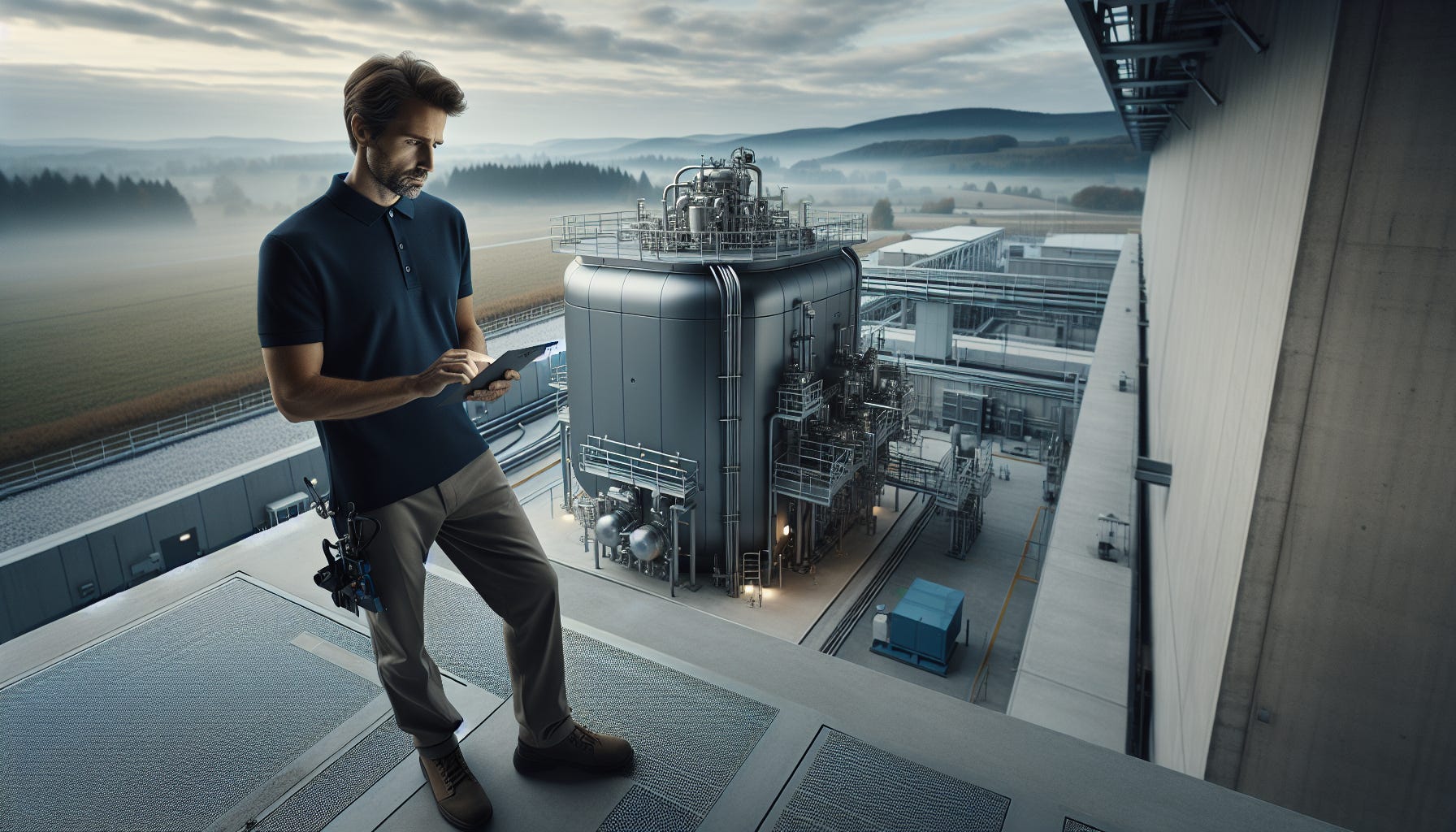
Picture a Wednesday afternoon in 2050. A steel mill in rural Ohio hums at full capacity, powered entirely by a pair of compact reactors sitting on a footprint smaller than a neighborhood park. In northern Finland, a remote town heats its homes and powers its hospital from a single modular unit that was factory-built in South Korea and shipped in three pieces. A cargo ship crosses the Pacific running on hydrogen produced by nuclear heat. None of these images feel far-fetched anymore. They feel, increasingly, like a reasonable bet.
This is not a prediction. Nobody with intellectual honesty claims to know what 2050 will look like. But if the SMR industry clears the very real hurdles in front of it — cost, construction timelines, public acceptance, fuel supply chains — the downstream effects on energy, industry, geopolitics, and daily life are genuinely remarkable. Worth thinking through. Worth mapping out.
The International Energy Agency projects that under ambitious policy support, SMR deployment could reach 190 GW globally by 2050, with cumulative investment approaching $900 billion. The Nuclear Energy Agency has identified 127 SMR technologies currently in development worldwide. Some of these will fail spectacularly. A handful will probably change everything. So: what does the world look like if that handful wins?
The electricity grid gets a proper backbone
The central problem of renewable energy has always been intermittency. The sun sets. The wind stalls. Batteries help at the margin, but they have not solved the dispatchability gap that makes grid operators quietly nervous. SMRs, if they scale, address this directly. They generate 24/7 electricity with no emissions and, in most designs, without the catastrophic failure modes of older large reactors. 🔋
In a world where SMRs succeed, the grid of 2050 probably looks like this:
Renewables handle most daytime generation in sunny and windy regions
SMRs provide baseload power and the flexibility to ramp when renewables drop
Industrial facilities co-locate their own reactors, pulling off the main grid entirely
Rural and island communities stop depending on diesel generators
Think about what that last point alone means. Right now, remote communities across Canada, Alaska, and parts of Scandinavia pay staggering prices for diesel-generated power. The Wikipedia entry on small modular reactors notes that microreactors under 20 MW are specifically being designed for exactly these markets. If a 10 MW unit can be dropped into a northern Canadian mining town the way a shipping container gets dropped on a dock, the economics of remoteness change fundamentally. ⚡
The data center industry has already figured this out. Microsoft, Google, and Amazon have all signed nuclear power agreements, though most won’t see electrons flowing until the mid-2030s at the earliest. By 2050, if costs have followed the learning curve that solar panels once did, those deals will look like the early adopter bargains that they are. 🌐
Is this utopian? A little. But the ITIF analysis makes a credible case that SMRs, unlike large reactors, genuinely can achieve cost reductions through factory production and serial deployment. The question isn’t whether the physics works. It does. The question is whether the economics and logistics do, too.
Industry finally cleans up its act
The dirty secret of the energy transition is that electricity grids get most of the attention, but hard-to-abate industries are where decarbonization gets genuinely hard. Steel. Cement. Chemicals. Ammonia. These sectors produce roughly a third of global CO₂ emissions, and wind and solar can’t directly reach most of them. They need heat, not just electrons. Really hot heat. 🏭
This is where the SMR story gets interesting in a way that most coverage misses. Several SMR designs — particularly high-temperature gas-cooled reactors like the Xe-100, which X-energy is deploying at Dow’s Seadrift plant in Texas — can produce industrial heat at temperatures high enough to replace fossil fuel combustion in manufacturing processes. According to a 2025 analysis tracked by Nucnet, SMRs could reach 700 GW of capacity by 2050 under a transformation scenario, with five industries alone accounting for over 75% of that opportunity:
Iron and steel production
Upstream oil and gas processing
Chemical manufacturing
Food and beverage production
District heating networks
In a world where those deployments happen, the steel mill in rural Ohio mentioned above isn’t a fantasy. It’s a market outcome. Nuclear heat replaces coal-fired blast furnaces. The hydrogen economy, which many analysts see as essential for shipping and aviation, runs on nuclear-produced green hydrogen rather than requiring vast renewable electricity capacity dedicated to electrolysis. 🔬
I think this is the most underappreciated dimension of the SMR story. Everyone talks about electricity. The real prize is heat. If SMR developers can consistently deliver high-temperature output at competitive cost, they unlock decarbonization pathways that simply don’t exist in a solar-and-wind-only world. What do you think the hardest industry to decarbonize actually is? The steel sector, with its ancient blast furnace infrastructure? Cement, where 60% of emissions come from the chemistry of the limestone itself? The answers might shape which SMR designs matter most.
Geopolitics runs on uranium
Here is where the optimistic 2050 scenario gets complicated. Because a world where SMRs succeed globally is also a world where nuclear technology exports become one of the most consequential geopolitical levers on the planet. And right now, two countries have a serious head start. 🌍
Russia and China have both deployed operational SMRs. Russia runs its floating KLT-40S reactors in the Arctic, and China brought its land-based ACP-100 online in late 2025. The United States, despite enormous private sector activity, has zero commercially operating Western-designed SMRs as of today. The CSIS analysis is blunt about the implications: nuclear commerce creates decade-long relationships between supplier and recipient countries. Whoever builds your reactor controls a significant portion of your energy security for a generation.
In a successful SMR world in 2050, the geopolitical map probably looks like one of two things:
A multipolar nuclear market where US, European, South Korean, and Japanese designs have matched or surpassed Russian and Chinese deployments, creating genuine competition and better terms for recipient countries
A bifurcated world where authoritarian-backed designs dominate the developing world and democratic designs hold the wealthy nations, with fuel supply chains becoming a permanent geopolitical flashpoint
The European Commission’s March 2026 strategy to deploy the continent’s first SMRs by the early 2030s is a direct response to this risk. The UK’s selection of Rolls-Royce as preferred bidder to build Britain’s first SMRs signals that some Western governments are finally treating this as the strategic competition it is, not just an energy policy question. 🤝
The first scenario is better for almost everyone. But reaching it requires the United States and its allies to move much faster than their current regulatory timelines suggest. The race is not merely commercial. It’s structural.
The communities that finally get left in
Zoom out from the geopolitics and you find a human story that matters just as much. Right now, energy poverty is one of the most stubborn constraints on development. Over 700 million people globally still lack reliable electricity access. The conventional answer, for decades, was to build out grid infrastructure and central generation capacity. That answer is slow, expensive, and has failed large parts of sub-Saharan Africa and South Asia on the timelines that mattered. 💡
A successful SMR world offers a different model. Smaller reactors mean smaller grid requirements. A single 50 MW unit can power a medium-sized city in a developing country without requiring the transmission infrastructure that large plants demand. Countries currently considering SMRs include Vietnam, Thailand, the Philippines, and Poland, according to Washington Quarterly research. Over 30 countries are actively planning or exploring new nuclear programs, many with little prior nuclear experience.
In 2050, if those programs succeeded:
Grid-connected communities in parts of Africa and Southeast Asia would have reliable, 24/7 power from domestic nuclear generation, not diesel or coal imports
Small island nations could eliminate their dependence on imported fossil fuels entirely
The economics of desalination change, because nuclear-powered desalination is already technically viable and becomes competitive at scale
The catch, and it’s a real one, is the waste question. Some studies suggest SMRs could produce two to thirty times the waste volume of large reactors, depending on design. This is not a reason to dismiss the technology, but it is a reason to take waste policy as seriously as deployment policy. A world with 700 GW of SMR capacity that has not solved long-term waste storage is trading one problem for another. 🌱
The reckoning still ahead
Let’s be honest about what a 2050 SMR success story does not solve. Because intellectual honesty matters more here than narrative tidiness.
Cost overruns have haunted nuclear for decades. The NuScale project in Idaho was cancelled in 2023 precisely because projected costs spiraled past what the utilities would absorb. The Arthur D. Little analysis notes that the industry faces a classic chicken-and-egg problem: supply chains won’t develop until demand is clear, and demand won’t materialize until supply chains exist. First-mover economics are brutal.
Regulatory harmonization is still a mess. The US Nuclear Regulatory Commission defines SMRs as only light-water reactors under 300 MWe, while the World Nuclear Association uses a broader definition. Different countries have wildly different licensing timelines, making international deployment far harder than proponents often admit.
Fuel supply chains remain dangerously concentrated. As of 2026, Russia effectively monopolizes the supply of HALEU (high-assay low-enriched uranium), which many advanced SMR designs require. China is the only other country with meaningful production capacity. This is a single point of failure that a successful SMR industry cannot afford to leave unaddressed. ⚠️
And then there is the question that doesn’t get asked enough: who decides where these reactors go, and who benefits from the decisions? The ScienceDirect energy justice research from late 2025 is pointed about the transparency problems already present in nuclear governance, where affected communities are regularly excluded from meaningful decision-making about infrastructure that will operate in their backyard for sixty years.
A world where SMRs succeed technically but fail socially is not a success. It’s a different kind of problem.
The 2050 question, ultimately, is not just can SMRs deliver, but who gets to decide how, and who bears the costs when something goes wrong. Those are political questions as much as engineering ones, and the engineering community has historically been better at the second than the first. If you’re tracking the SMR story closely, which of these barriers do you think is most likely to derail the whole thing: costs, fuel supply, waste policy, or public acceptance? The answer might determine whether that Ohio steel mill and that Finnish town are history or just a very expensive thought experiment.