


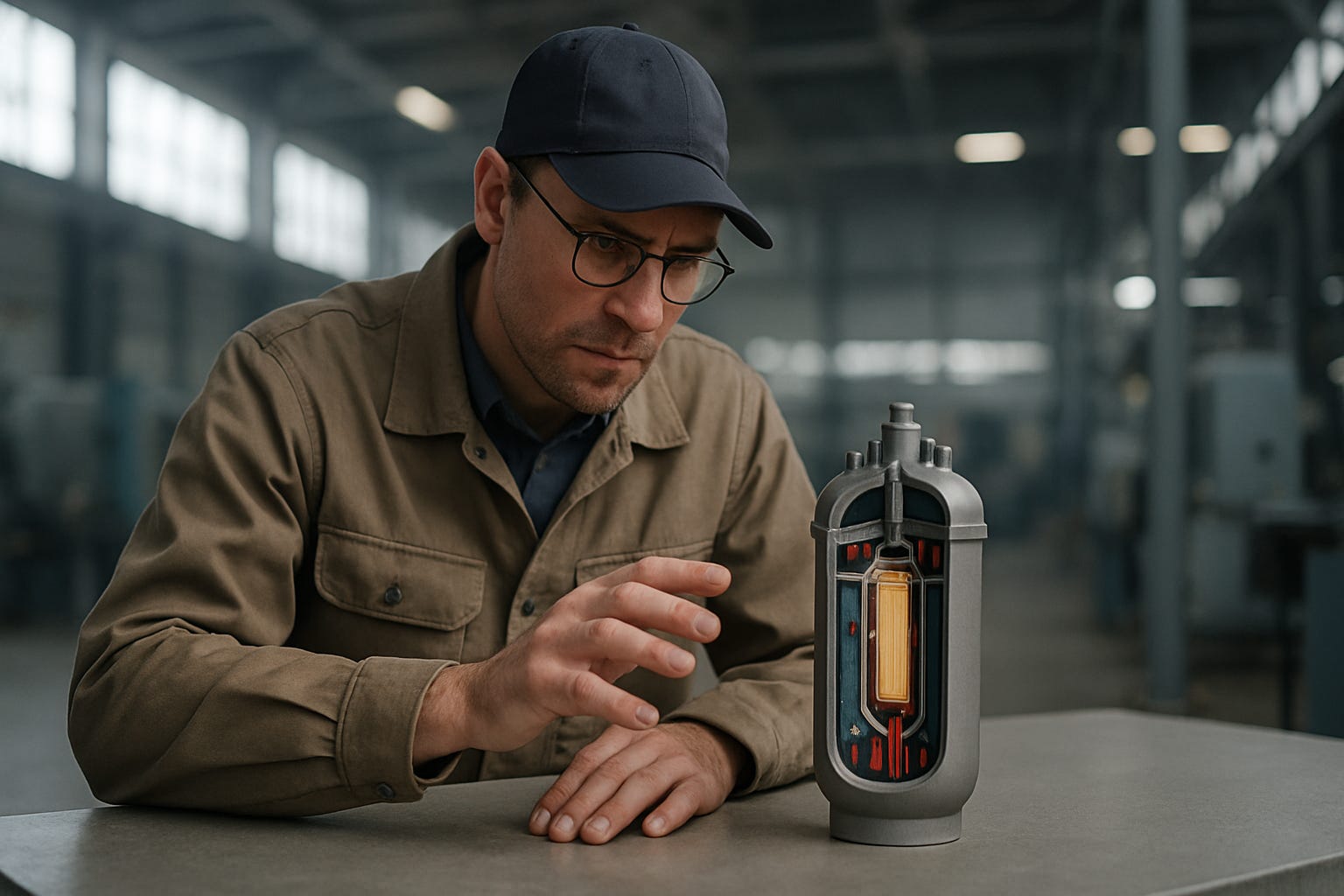
Forget the cooling towers. Forget the sprawling site the size of a small town. A small modular reactor, or SMR, is closer in scale to something you’d see parked at a shipyard: a sealed vessel, often built to be shipped by truck or rail, quietly making heat. ⚛️ That image has powered a wall of investor decks and government press releases for years, and in 2026 it’s finally getting tested against something less forgiving than a slide: actual concrete, actual regulators, and actual electricity bills. So what is this thing, really, and how does it turn uranium into power without the footprint of a conventional plant? Here’s the five-minute version. 🔬
What “small” and “modular” actually mean
The two words in the name are doing separate jobs, and mixing them up is where most confusion starts. Small refers to output. ⚡ The International Atomic Energy Agency puts the ceiling at 300 megawatts of electricity per module, roughly a third of what a single conventional reactor puts out. Modular refers to how the thing gets built: in a factory, in standardized pieces, rather than poured and welded together on-site over a decade. 🏗️ The World Nuclear Association frames SMRs around factory fabrication, chasing the economies of series production and shorter construction times, which is genuinely the whole economic bet in a sentence. Build the same box a hundred times in a controlled factory, the theory goes, and you dodge the cost overruns that have plagued one-off mega-projects for decades.
Not every “small” reactor is modular, and the category actually splits into a few tiers:
Microreactors: under 10 MWe, small enough for a military base or a remote mine
SMRs proper: 10 to 300 MWe, the sweet spot most companies are chasing
Large conventional reactors: 1,000+ MWe, the traditional utility workhorse
Process-heat SMRs: sized and rated in megawatts thermal instead of electric, built to heat industrial facilities rather than push power onto a grid
That last category matters more than people think. Developers are increasingly engineering SMRs to integrate directly with industrial energy systems, acting as nuclear boilers and behind-the-meter generators rather than utility-scale power stations feeding a transmission grid. Refineries, aluminum smelters, and steel plants need heat that solar and wind simply can’t deliver on demand, and that gap is a big part of why SMRs are having a moment. 🏭
The physics: same fission, smarter plumbing
Strip away the marketing and an SMR runs on the exact same principle Enrico Fermi proved out under a football stadium in 1942: split uranium atoms, capture the heat, boil water, spin a turbine. Just like a full-size reactor, the fission heat boils water into steam, and that steam turns a turbine and generator to make electricity. Nothing exotic there. The real engineering happens in what carries that heat away from the core, and this is where SMR designs actually start to diverge from each other and from their bigger cousins. 🔥
Most reactors currently working through licensing are still light-water reactors (LWRs), the same coolant technology that has run the global nuclear fleet for seventy years, just shrunk and simplified. 🌡️ But the pipeline behind them looks noticeably more varied:
Light-water SMRs (NuScale, Holtec’s SMR-300): water-cooled and water-moderated, the safest bet regulators already understand
High-temperature gas reactors (X-energy’s Xe-100): helium-cooled, pebble-bed fuel, designed for industrial process heat
Sodium-cooled fast reactors (TerraPower’s Natrium): liquid metal coolant paired with molten-salt energy storage for load-following power
Molten salt reactors (Kairos Power, Terrestrial Energy): fuel dissolved directly in the coolant salt, which changes the safety math entirely
Each of these is chasing a genuinely different customer. A utility wants something that slots into the existing grid without drama. A chemical plant wants steady, very hot process heat. A data center operator wants firm power that doesn’t blink when clouds roll in. One reactor type won’t satisfy all three, which is exactly why so many competing designs are still in the running instead of the field narrowing to a winner. 📈 Which of those customers do you think ends up driving the most actual construction by 2030?
Passive safety: why these things are built to babysit themselves
Ask any SMR developer what separates their design from a 1970s-era plant and you’ll get the same answer within thirty seconds: passive safety. 🛡️ The idea is that if something goes wrong, physics handles the emergency instead of a control room full of operators scrambling for backup power. Passive safety systems lean on natural phenomena instead of powered equipment: gravity-fed cooling lines that open automatically during an outage, or natural convection, where a heated fluid rises and pulls cooler fluid in behind it, keeping a cooling cycle running on its own. ⚙️ No diesel generators. No frantic pump restarts. Just water finding its way downhill. 💧
NuScale’s version of this is a good concrete example. According to the Department of Energy, its emergency core cooling valves are simpler than those in traditional reactor designs and open automatically without extra pumps, power, or operator action, which lowers both the failure points and the capital cost. Holtec makes an even bolder claim about its SMR-300, describing it as “walk-away safe” because the fuel stays cooled indefinitely without anyone touching a switch.
That said, “walk-away safe” deserves a raised eyebrow, not a standing ovation. A closer read of the safety literature is more careful:
Passive systems reduce, but don’t eliminate, the need for human oversight
Operators still monitor plant status and manage non-safety functions during an event
Materials used in passive systems need long-term performance validation, since some designs are genuinely new
Simulator training has to account for how passive systems behave differently than active ones, which regulators are still working through
These designs aim to prevent fuel damage for extended periods without anyone stepping in, but that doesn’t eliminate the need for human response entirely. It’s a real safety improvement, not a magic trick, and the honest version of the pitch says so. If you want the full regulatory paper trail behind each design’s safety case rather than the marketing summary, SMRbrief Pro is where that gets tracked design by design.
Where things actually stand right now
Here’s the part most explainers skip: how far along is any of this, actually? As of mid-2026, NuScale remains the only SMR with full NRC design certification, for its uprated 77 MWe US460 design approved in May 2025, and that certification process itself is worth understanding if you’re wondering how long it actually takes to get a new reactor design blessed by regulators. Behind NuScale, the field is crowded but moving. TerraPower’s Natrium design has a construction permit application working through NRC review for its Kemmerer, Wyoming demonstration plant, and Meta has already signed on for up to eight Natrium plants down the line. X-energy’s Xe-100 is working through review for a Dow Chemical facility in Texas. Kairos Power holds a construction permit for its Hermes test reactor in Oak Ridge, Tennessee. Holtec’s dual-unit SMR-300 project, called Pioneer, cleared an early NRC docketing step in February 2026.
A few data points worth sitting with 📊:
BWRX-300 (GE Hitachi) is already under construction at Ontario’s Darlington site, ahead of most US competitors
NANO Nuclear’s microreactor cleared NRC construction-permit acceptance for a University of Illinois deployment in May 2026
The EU’s SMR Strategy, adopted in March 2026, formally targets SMRs at hard-to-decarbonize industries like petrochemicals and steel
None of this is fast: TerraPower’s own timeline points to years of review before turbines spin
I’ll be honest about the tension here: the industrial logic for SMRs is strong, the safety engineering is genuinely improved over older designs, and yet the actual build record so far is thin. ⚡ One certified design, a handful of permits, and a lot of promised timelines that keep sliding to the right. That gap between the pitch and the concrete is exactly what to watch over the next two years. 🚀 So the real question isn’t whether SMRs can work. It’s whether any developer can actually ship one on time, on budget, and at the price they promised, before investor patience runs out. What would it take to convince you either way?