


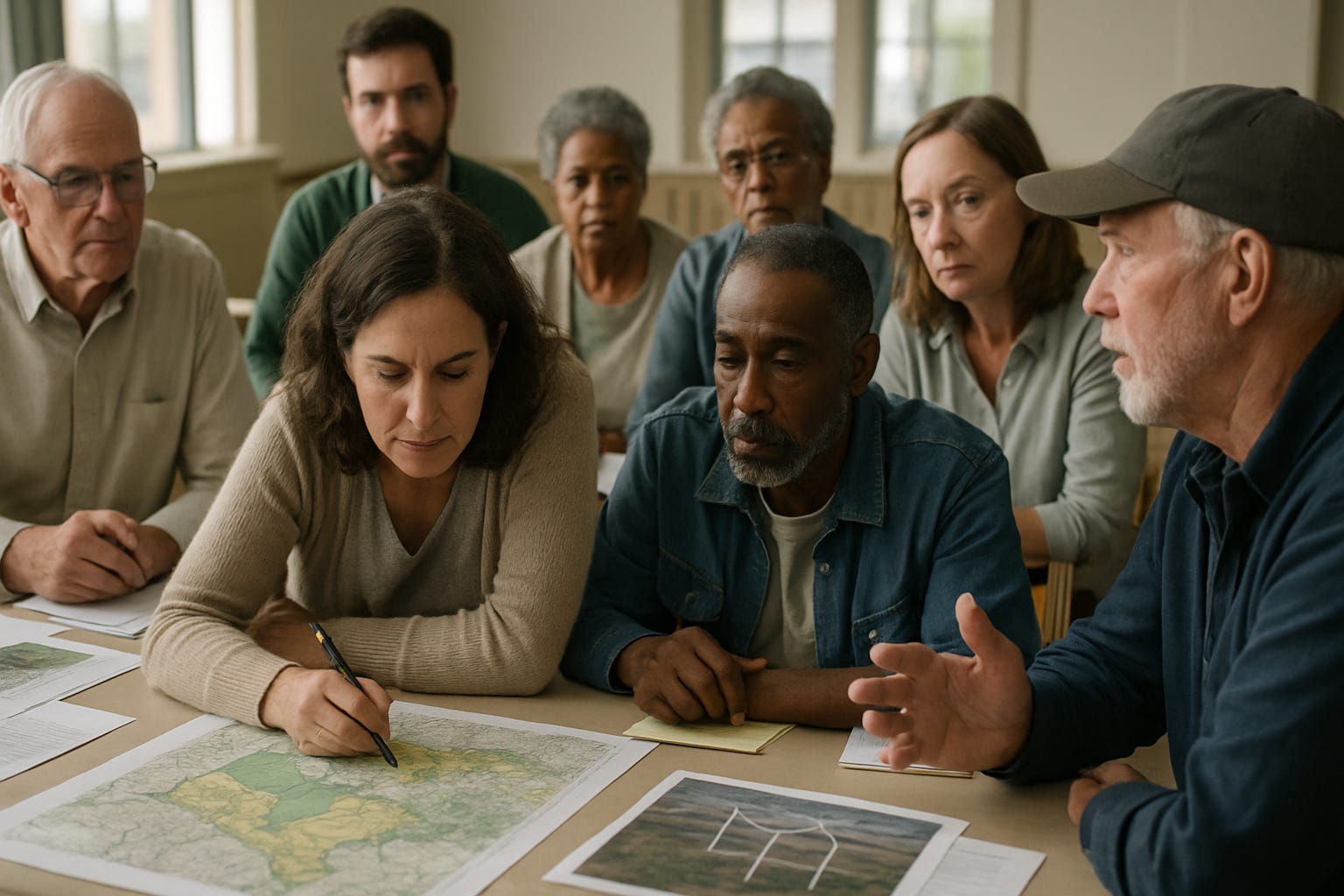
If you live within a few miles of a proposed small modular reactor site, you probably have a lot of questions. Whether the project actually proceeds depends, to a degree that surprises most people, on what you and your neighbors do during a specific window of legal process. Not on a petition. Not on a hashtag. On a formal federal licensing procedure with well-defined opportunities to intervene, comment, and push back.
This is not the same as having a veto. Let’s be clear about that upfront. The federal government’s nuclear licensing system doesn’t give a community the right to simply say “no” and end the conversation. But the process is more substantive than a rubber stamp, and recent changes to both federal law and state-level legislation have made the community side of the equation more complex and, in some cases, more consequential than ever.
Here’s how it actually works.
The federal process and where public input lives
Every commercial SMR built in the United States requires a license from the Nuclear Regulatory Commission (NRC). This is non-negotiable, regardless of what state or county wants. The NRC’s authority over nuclear licensing is federal and supersedes state law on the core safety and design questions. But federal law also requires the NRC to follow the National Environmental Policy Act (NEPA), and that’s where the public gets meaningful traction. 🏛️
When an applicant submits a construction permit application, the NRC publishes a Notice of Intent to prepare an Environmental Impact Statement (EIS), a document that evaluates the project’s effects on land, water, air quality, local ecosystems, and the surrounding community. According to the NRC’s own environmental review guidance, the NRC then:
Publishes a draft EIS for public comment before finalizing it
Holds public scoping meetings to let residents and local agencies flag the environmental questions they want studied
Must respond in the final EIS to every substantive comment received
Consults with tribal, state, and local agencies throughout the process 🔍
The NRC also convenes a formal Atomic Safety and Licensing Board (ASLB) hearing for each major licensing action. Under Section 189 of the Atomic Energy Act, members of the public can submit written statements, give oral testimony, or petition to intervene as full parties in the proceeding. Intervening as a full party is a much stronger position than simply filing a comment: intervenors can challenge specific technical or environmental claims, submit expert witnesses, and request access to applicant documents. ⚖️
This is where projects have actually been slowed or modified. Legal interventions during the licensing process are one of the mechanisms that kept the nuclear industry legally accountable after Three Mile Island, and the framework remains in place today.
What recently changed, and what it means for communities
The ADVANCE Act of 2024, signed into law with an overwhelming 88-2 Senate vote and 393-14 in the House, directed the NRC to streamline its licensing process significantly. Harvard Law Review’s analysis of the ADVANCE Act notes that while the law cuts fees for advanced reactor applicants and sets tighter timelines for technical reviews, it preserves mandatory hearings before construction can begin, and it doesn’t eliminate the environmental review process. 📋
Then in April 2026, the NRC finalized a Generic Environmental Impact Statement (GEIS) for new reactor licensing, which went into effect in May 2026. What this means practically: environmental impacts that are common across reactor types and sites, things like general air quality effects or seismic considerations, can now be evaluated generically rather than being re-studied from scratch for every project. Site-specific impacts still require individual analysis, and the public comment process for those site-specific findings remains intact.
The honest read is that these reforms reduce some redundancy in the process, but they don’t gut public participation. 🔎 Here’s what has not changed:
Site-specific environmental issues still require project-specific public review
Mandatory NRC hearings remain before construction permits are issued
The right to petition for full intervenor status remains
NEPA compliance, including consultation with local and tribal governments, is still required
State and local agencies must still be notified and consulted during the review 🌍
What has changed is the timeline. The ADVANCE Act set a target of 18 months for the NRC to complete technical safety reviews, and two years for completing environmental assessments and public hearings. Faster proceedings mean that community groups opposing or wanting to shape a project need to engage earlier and more substantively than in the old era of decade-long licensing marathons.
The state layer, which is where it gets complicated
Federal licensing is the floor, not the ceiling, and state laws introduce a genuinely variable second layer of authority. 🗺️ Some states have nuclear moratoriums, some are actively removing them, and a small number have started experimenting with formal consent mechanisms.
As of early 2026, the Nuclear Energy Institute’s tracker lists the following state-level positions: ⚖️
States with full nuclear moratoriums that predate SMR technology, including California, Minnesota, and Oregon
States that have partially lifted moratoriums for specific sites or technologies
States that are actively passing new SMR-friendly legislation in 2025 and 2026
Connecticut, which in 2025 passed Act 25-173, enabling communities to “opt in” to hosting advanced reactor facilities through a local vote, while also establishing a Site Readiness Funding Program
That Connecticut law is interesting because it’s one of the first state-level mechanisms that gives communities a formal yes/no role, not just input into a federal process. If other states follow, it may shift the community question from “can we slow or stop this?” to “do we want this and what do we want in return?”
The R Street Institute’s analysis of state and local permitting restrictions makes a nuanced point: states can impose additional environmental requirements through NEPA-facilitated compliance, which can indirectly affect siting decisions even without explicit anti-nuclear laws. A state with a stringent groundwater protection regime, for example, forces any applicant to address those requirements in the EIS, giving state regulators a real voice in the process. 🌊
What communities actually do in practice, from Kemmerer to Oak Ridge
Theory and practice diverge in interesting ways once real communities get involved. The TerraPower Natrium project near Kemmerer, Wyoming, offers one of the more instructive current examples. When the NRC held a public scoping meeting on the project’s environmental review, local residents showed up with very specific concerns: groundwater contamination risks, potential impacts on the Colorado River Basin watershed, how long radioactive waste would be stored on-site, and what would happen if an archaeological site was discovered during construction. Wyoming News reporting from those meetings captured the texture of a community that is cautiously supportive of the economic opportunity but genuinely worried about the technical details. 🏔️
These aren’t objections that can be waved away. The NRC’s process requires the agency to document and respond to each one. If the draft EIS doesn’t address groundwater effects adequately, a commenter can flag that deficiency, and if the NRC fails to address it substantively in the final EIS, that becomes grounds for a legal challenge.
The Kairos Power Hermes demonstration reactor in Oak Ridge, Tennessee, went through a similar community engagement process before receiving its construction permit in December 2023, the first permit for a non-light-water reactor in more than 50 years. ⚛️ Oak Ridge’s existing status as a nuclear community, home to the Oak Ridge National Laboratory, probably helped public acceptance. The same dynamic likely wouldn’t apply in a community with no prior nuclear relationship.
That community familiarity effect is real and documented. A 2025 poll cited by WSP’s nuclear engagement analysis found that while 65% of UK respondents say nuclear should remain part of their country’s energy mix nationally, only 22% would support construction of a nuclear plant in their own area. Opposition specifically to a local facility runs at 37%. That gap between national support and local acceptance is the defining political challenge for the entire SMR deployment agenda. 📊
What communities can actually do: a practical guide
If an SMR is proposed near you, the tools available in the U.S. context are more specific than “write to your congressman.” 💬
Participate in NRC scoping meetings: These happen early in the EIS process and are your best chance to identify the specific environmental questions you want studied. Comments at this stage actually shape what gets analyzed. 🔬
File written comments on the draft EIS: Once the draft is published, there’s a formal public comment period. Comments must be substantive to receive written responses, so specific and technical beats vague and emotional.
Petition to intervene in the ASLB hearing: This is the most powerful individual option. To intervene, you need to demonstrate “standing” (that you’re genuinely affected) and raise an “admissible contention” that disputes a specific factual claim in the application. Environmental groups like the Union of Concerned Scientists have used this mechanism successfully in past licensing proceedings.
Engage your state regulatory agencies: States are consulted during the federal EIS process and may have their own environmental review requirements. Your state’s environmental protection or natural resources agency may have independent authority over aspects like water use or land impact.
Monitor state legislation: If your state is considering SMR-related legislation, the window to shape community consent provisions is before a project is proposed, not after. 📋
Negotiate community benefit agreements: If a project proceeds, many communities have successfully negotiated formal agreements with developers covering local hiring requirements, economic benefits, and operational transparency. These aren’t part of the NRC process, but they’re legally enforceable contracts. 🤝
The IAEA’s March 2025 event on SMR stakeholder engagement noted a specific concern: meaningful global SMR deployment would require hundreds of local communities to host reactors, and “not-in-my-backyard” dynamics are an underappreciated constraint on deployment timelines. Vendors and developers who treat community engagement as a box-checking exercise rather than a genuine negotiation are going to discover this the hard way.
The communities that have gone well so far, Kemmerer being the clearest example, share a common thread: the reactor was arriving in the context of a dying coal economy, meaning residents saw the plant as a replacement for something they were already losing. In communities without that existential economic pressure, the negotiation looks quite different.
What does your community actually want from an SMR developer before you’d say yes? That’s not a rhetorical question, it’s the question that will determine whether hundreds of planned projects get built or stall.