


Most people have a vague sense that nuclear energy involves atoms, heat, and something dramatic. They’re right on all three counts. But the actual journey, from the fission of a single uranium nucleus to the alternating current entering your wall socket, is one of the most satisfying chains of cause and effect in all of engineering. Every step follows logically from the last. Nothing is magic. And once you understand it, you’ll never look at a light switch the same way.
Small modular reactors work by the same fundamental physics as every nuclear plant ever built. What makes them different isn’t the science. It’s the scale, the manufacturing approach, and some genuinely clever engineering choices built around passive safety. But before we get to what’s new, you need to understand what’s foundational.
Step one: the fuel, and why it’s extraordinary
Everything starts with uranium. Not the science-fiction glowing green stuff. The real thing is a dull, heavy metal that looks unremarkable in a drawer. But inside its nucleus sits an almost absurd amount of stored energy, and the isotope uranium-235 is particularly ready to give it up.
Before uranium goes anywhere near a reactor, it goes through a multi-step preparation process:
It’s mined from ore deposits, primarily in Kazakhstan, Canada, and Australia
It’s converted and enriched to increase the concentration of U-235 from its natural level of less than 1% to around 3-5% for light-water reactors
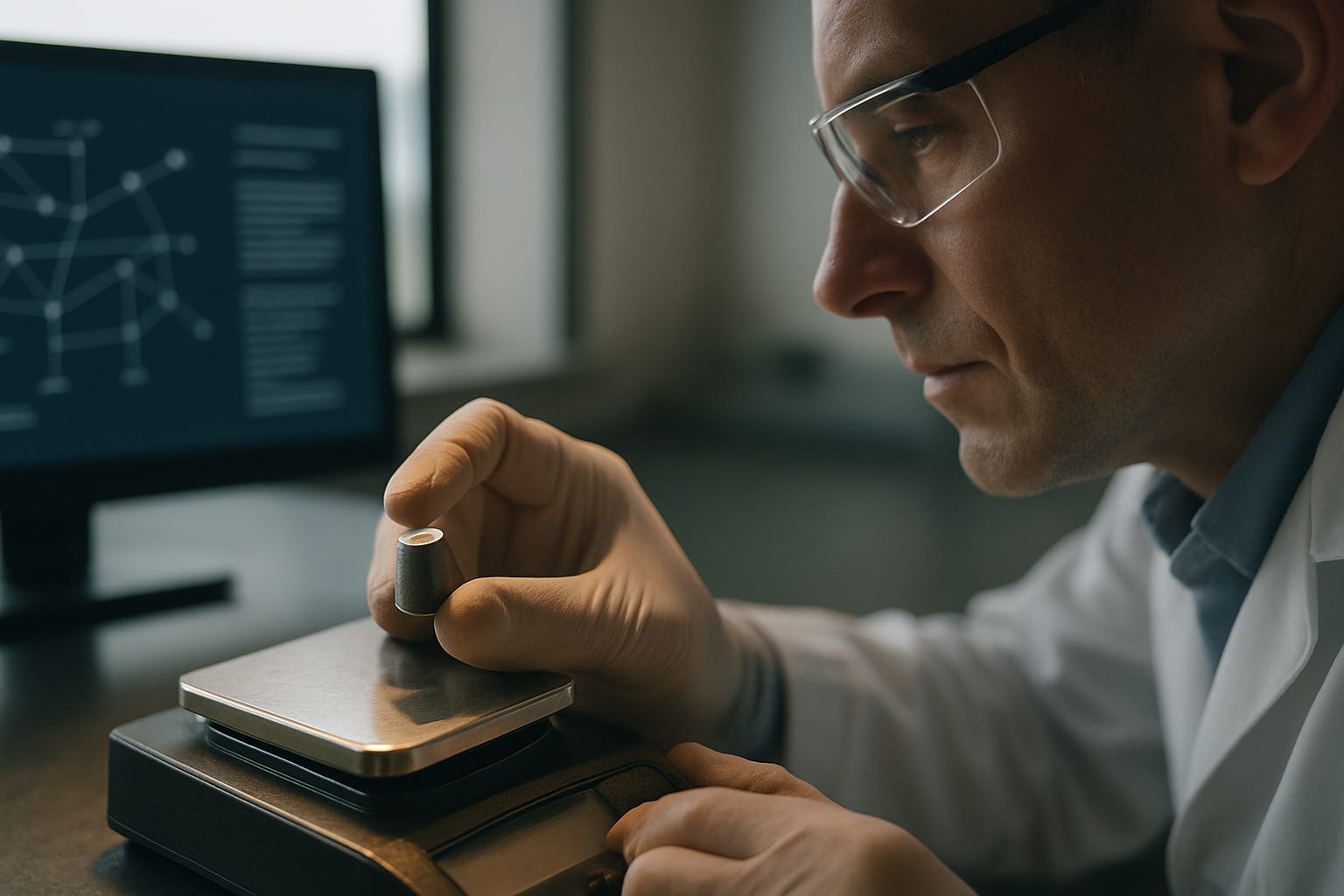
The enriched material is pressed and baked into small ceramic cylinders called fuel pellets, roughly the size of a pencil eraser
Those pellets are stacked inside sealed metal tubes called fuel rods, made from a zirconium alloy
Hundreds of fuel rods are bundled together into a fuel assembly, which slots into the reactor core
Now here is the statistic that stops people cold every time. ⚛️ According to the Nuclear Energy Institute, a single uranium fuel pellet weighing about ten grams, fitting easily on your thumbnail, contains as much energy as one ton of coal, 149 gallons of oil, or 17,000 cubic feet of natural gas. 💡 That’s the proposition. That’s why nuclear engineers sound slightly evangelical when they talk about their fuel.
An SMR core holds far fewer assemblies than a large conventional reactor, reflecting its smaller output. 🔬 The NuScale Power Module, for example, produces 77 megawatts of electricity ⚡ from a compact reactor vessel that fits in a swimming-pool-sized containment module. The GE-Hitachi BWRX-300 tops out at 300 megawatts, comparable to a mid-sized gas plant, but from a core you could park in a decent-sized warehouse. The physics doing the work inside that core is what we cover next.
Step two: fission, and the chain reaction that makes it run
Here’s where it gets genuinely interesting. ⚡
When a slow-moving neutron strikes a U-235 nucleus, the nucleus becomes unstable and splits, a process called fission. It breaks into two smaller atoms, releases two or three new neutrons, and critically releases an enormous burst of energy as heat. According to the U.S. Energy Information Administration, those free neutrons then strike other U-235 nuclei, which split and release more neutrons, which strike more nuclei. This is the chain reaction: a self-sustaining cascade of splitting atoms, each one adding to the heat output.
Left completely unchecked, a chain reaction like this produces a bomb. Inside a reactor, the whole point is to keep it controlled, running just fast enough to produce steady heat, not fast enough to run away. Three mechanisms manage this:
Control rods, typically made of boron or silver, absorb neutrons. Push them deeper into the core, and the reaction slows. Pull them out, and it accelerates. Push them all the way in and the reactor shuts down. The Rolls-Royce SMR design runs control rods through three separate coolant loops to manage this with redundancy.
The moderator, usually ordinary water, slows neutrons down to the speed where fission is most efficient. Water does double duty here: it moderates the reaction and carries heat away from the core.
Passive physics kicks in if something goes wrong. If coolant temperature rises, the water’s density drops and it becomes a less effective moderator, which automatically slows the reaction. No operator action required. 🛡️ This is called a negative temperature coefficient, and it’s one of the reasons modern SMR designs are sometimes described as “walk-away safe.”
The GE-Hitachi BWRX-300 takes this principle even further. 🔩 Rather than using mechanical pumps to circulate coolant through the core, it relies entirely on natural circulation. Hot water rises through a chimney-like structure in the reactor vessel, cooler water falls back down around the outside, and the density difference keeps the loop running on pure physics. No pumps means fewer things that can fail.
The net result of all this controlled fission is straightforward: a lot of heat. 🌡️ And heat, in the end, is all a nuclear reactor actually produces. Everything else is about what you do with it.
Step three: making steam, the pressurized water path
Now we need to turn heat into motion, and the intermediate step is steam. 💧 This is where nuclear power and coal power look almost identical at the level of a process diagram. The physics of generating electricity hasn’t fundamentally changed since the 19th century: you boil water, use the steam to spin a turbine, and the spinning turbine drives a generator. ♨️
Most SMR designs, including the Rolls-Royce SMR and NuScale, are pressurized water reactors (PWRs). Here’s how the heat transfer works in a PWR:
The coolant water in the primary loop flows through the reactor core, absorbing heat from the fuel rods
This water reaches temperatures around 300 degrees Celsius but doesn’t boil because it’s kept under extreme pressure, roughly 155 times atmospheric pressure, maintained by a device called a pressurizer
The hot, pressurized water passes through a steam generator, where it transfers its heat to a completely separate secondary loop of water
That secondary water does boil, producing high-pressure steam
The steam expands through the blades of a turbine, spinning it at high speed
A condenser then cools the steam back into water, and the cycle repeats
The two water loops never actually mix. The primary loop, which passes through the reactor and picks up some radioactivity, stays entirely contained. The secondary loop, the one making steam and spinning the turbine, is clean. This separation is one of the core safety features of PWR design.
The IAEA puts it plainly: the reactor coolant warms to produce steam, the steam spins turbines, and the turbines activate an electric generator to create low-carbon electricity. Strip away the engineering jargon and that’s genuinely the whole story.
The GE-Hitachi BWRX-300 works somewhat differently, as a boiling water reactor (BWR). Rather than a separate steam generator, the water in the reactor vessel itself boils, and the steam goes directly to the turbine. ⚙️ Fewer components, simpler system. Though it means the steam that touches the turbine has been in the reactor, which requires some additional containment thinking. Either way, steam spins the turbine.
Step four: from spinning turbine to alternating current
The turbine is spinning. Now what? 🔌
The turbine shaft connects directly to a generator, essentially a large electromagnet rotating inside a set of coils. By the principle of electromagnetic induction, discovered by Michael Faraday in 1831 and still the basis of virtually all electricity production on Earth, the rotating magnetic field induces an electrical current in those coils. ⚡ This is what a generator does: it converts mechanical rotation into electrical current.
The electricity produced this way is alternating current (AC), typically at a frequency of 50 or 60 Hz depending on the country. At this stage, the voltage is relatively low and not suitable for long-distance transmission. So before it goes anywhere near the grid, it passes through a step-up transformer, which raises the voltage dramatically, from perhaps a few thousand volts to hundreds of thousands, for efficient transmission across power lines. 📡
Have you ever stopped to wonder how many transformations the current in your wall outlet has gone through? The number is higher than most people expect.
A single 300 MWe SMR running at a 90% capacity factor, the typical figure for nuclear plants, notably higher than wind or solar, generates roughly 2.4 terawatt-hours of carbon-free electricity per year. That’s enough to power around 200,000 homes, according to analysis published by Sustainability Atlas. Nuclear plants run about 92% of the time. The best-performing offshore wind farms average closer to 45-50%.
Step five: what the grid sees, and why SMRs matter to it
The electricity leaves the step-up transformer, joins the high-voltage transmission grid 🔋, and at some point gets stepped back down by another transformer before entering the distribution network that reaches your neighborhood. By the time it hits your wall socket, multiple voltage transformations have occurred and the power has traveled, in many cases, hundreds of kilometers. 🌍
What the grid actually needs, and struggles to get from renewable sources, is firm, dispatchable baseload power: electricity available 24 hours a day, 7 days a week, regardless of whether the sun is shining or the wind is blowing. This is exactly what nuclear produces, and it’s precisely why there’s renewed interest in SMRs from energy-hungry tech companies.
The numbers tell the story:
Global electricity demand is projected to grow 75% by 2050, according to the IEA’s World Energy Outlook 2024, driven by EVs, heat pumps, and data centers
A single large AI training cluster can demand 500 megawatts of continuous power, roughly two large SMRs worth of output
The Department of Energy has allocated $900 million specifically to support initial SMR deployment, targeting designs ready for the 2030s
Nuclear fission companies raised $1.3 billion in equity funding in 2025 alone, the highest annual total on record
The modular approach matters here too. Rather than commissioning a single massive reactor and waiting a decade for it to come online, an operator can deploy one SMR module, add a second as demand grows, and build out capacity incrementally. The physics in each module is identical; the output just scales up. This is the logic that makes the factory fabrication model viable: build the same module hundreds of times, drive down costs through repetition, and ship the finished unit to the site rather than constructing a one-of-a-kind structure from scratch.
Not every SMR project has gone smoothly. NuScale’s VOYGR project for the Utah Associated Municipal Power Systems was cancelled in 2023 after cost estimates rose substantially, a useful reminder that the engineering is proven while the economics are still being worked out. 📊 The gap between “the technology works” and “the technology is cheap” is real, and honest. But the IEA projects global SMR capacity could reach 120 GW by 2050 with strong policy support, and the investment dollars flowing in suggest a lot of smart people believe the cost curve will bend.
The full picture: six grams to gigawatts
So let’s run the chain one more time, end to end. ⚛️
A uranium pellet weighing six grams sits inside a fuel rod in the reactor core. A slow neutron strikes a U-235 nucleus. The nucleus splits, releasing heat and more neutrons. 🔬 The chain reaction sustains. The coolant water absorbs the heat. In a PWR, that hot pressurized water transfers its energy to a secondary loop in the steam generator. Steam forms. Steam expands through a turbine, spinning it at thousands of RPM. The turbine drives a generator, a rotating electromagnet inside copper coils. Alternating current flows. 💡 A step-up transformer raises the voltage for transmission. Power lines carry it across a region. A step-down transformer lowers it for local distribution. You flip a switch, and a light comes on.
The chain from atom to light switch is about 15 steps long. Every step converts energy from one form to another: nuclear binding energy to heat, heat to steam pressure, steam pressure to mechanical rotation, mechanical rotation to electrical current. Some energy is lost at each conversion, which is why an SMR that produces 900 megawatts of thermal power might deliver only 300 megawatts of electricity. The thermal efficiency of a steam cycle is typically around 30-35%.
The remarkable thing isn’t the losses. It’s that one fuel pellet you could hold between two fingers contains enough energy to run a house for 25 years. A reactor full of those pellets, running for 18 months before a refueling outage, produces as much electricity as over two million tonnes of coal would. And it does it without any stack emissions, without any carbon, and with a vanishingly small accident risk in a modern SMR with passive safety systems.
Think about that the next time you make coffee. How much do you know about where the electrons in your mug’s heating element actually came from, and does knowing the full chain make the coffee taste any different?