


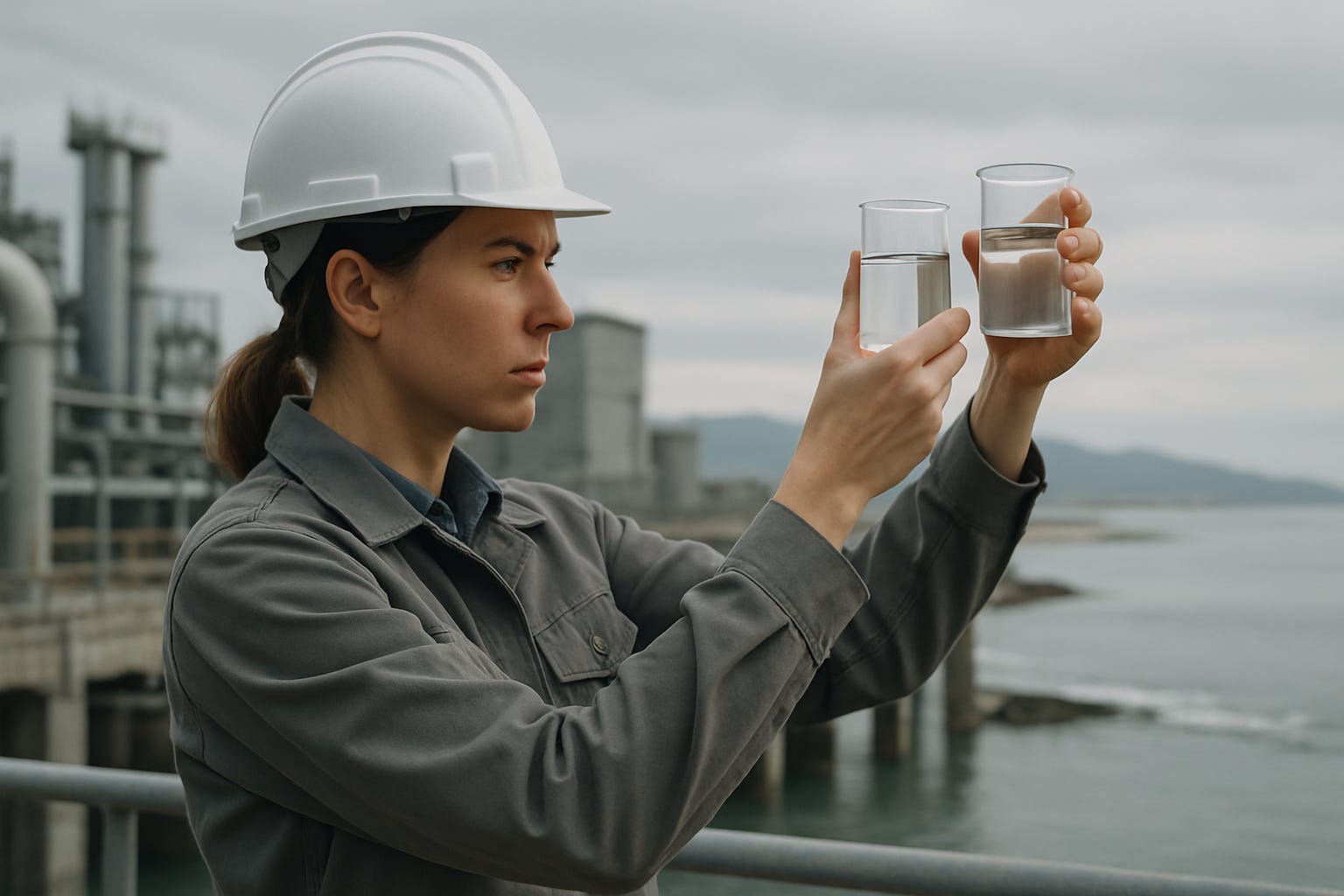
When people talk about small modular reactors, they almost always talk about electricity. Megawatts. Grid decarbonization. AI data centers. The conversation stays firmly in the domain of kilowatt-hours, and that’s understandable — power generation is what nuclear does most visibly.
But there’s a second application that doesn’t get nearly the same attention, despite a track record stretching back to 1973 and growing urgency in 2026. Nuclear desalination — using reactor-generated heat and electricity to pull drinkable water from the sea — is older than most people realize and more ready for SMR integration than the coverage suggests. According to the IAEA’s own accounting of nuclear cogeneration history, reactors in India, Japan, and Kazakhstan have accumulated over 200 reactor-years of operational experience in desalination. This isn’t a concept. It’s a proven process that never got the commercial scale it deserved — partly because cheap fossil fuels made it unnecessary for most of the 20th century.
That calculus is changing fast. More than two billion people currently lack reliable access to safe drinking water, according to the World Nuclear Association’s August 2025 report on desalination. By 2050, nearly half the world’s population is expected to live in water-stressed regions. And the countries most desperate for clean water are overwhelmingly the same countries baking under intense sun with long coastlines — precisely the places where nuclear desalination makes technical and economic sense. 🌊
This is the dual-use case nobody in the SMR industry is shouting about loudly enough.
The physics of why this works
Nuclear reactors produce two things: electricity and heat. Traditional power plants throw away the heat. They convert roughly a third of their thermal output into electricity and dump the rest into rivers, oceans, or the air. It’s a known inefficiency baked into every conventional nuclear design, one that policymakers and engineers have tolerated because electricity was the point.
Desalination needs both electricity and heat, depending on which process you use. Thermal desalination, including multi-stage flash distillation (MSF) and multi-effect distillation (MED), uses direct heat to boil seawater and collect the condensed freshwater. Reverse osmosis (RO) uses high-pressure pumps powered by electricity to push seawater through semi-permeable membranes that block salt. RO now accounts for roughly 85% of global desalination plants because it’s more energy-efficient than thermal methods per cubic meter of output.
An SMR can feed both. 💡 It can dedicate electrical output to drive RO systems while simultaneously routing waste heat into thermal desalination units. Or it can do RO exclusively, with the nuclear plant’s baseload electricity running the pumps 24 hours a day without intermittency, which is exactly the kind of always-on power that solar-driven RO struggles to deliver.
The key advantages of pairing SMRs with desalination come down to:
No carbon emissions: nuclear desalination has lifecycle carbon emissions two to three orders of magnitude lower than fossil-fuel-powered plants, per a 2022 peer-reviewed study in Desalination journal
Reliability: unlike solar or wind-powered RO, an SMR runs at full capacity regardless of weather — membranes and pumps work best under steady-state conditions, not variable loads
Cogeneration efficiency: heat that would otherwise be wasted gets a second job, improving the overall economics of the plant
Siting flexibility: SMRs are smaller than conventional reactors, which means they can be built closer to coastal communities that need water rather than centralized far from demand 🔬
The World Nuclear Association’s desalination resource page notes that nuclear cogeneration plants have been built and operated in Bulgaria, Canada, Germany, Hungary, India, Japan, Kazakhstan, Russia, Slovakia, Switzerland, and the United States. Almost 500 reactor-years of combined operational experience in various cogeneration applications, and the safety record is essentially clean. Design precautions to prevent the transfer of radioactivity into desalted water have proven effective in every deployment.
NuScale’s triple play: water, power, and hydrogen
The most detailed recent blueprint for SMR-driven desalination comes from NuScale Power, whose research announced in mid-2025 lays out a system that’s genuinely clever in how it chains outputs together.
According to NuScale’s announcement and a detailed analysis in Power magazine, a single 77-MW NuScale Power Module (NPM) coupled to a reverse osmosis system could yield approximately 150 million gallons of clean water per day without generating carbon dioxide. Scale that up to a 12-module plant and you get enough desalinated water for a city of 2.3 million residents, with surplus electricity to power 400,000 homes on top.
That’s an impressive headline number. The part that makes it genuinely interesting, though, is what NuScale plans to do with the brine. 🧬
Brine is the concentrated salt waste that comes out the back end of every desalination plant. It’s an environmental problem: dense, hot, chemically concentrated, and bad for marine ecosystems when dumped carelessly. The standard approach is to dilute it before ocean discharge, which adds cost and energy. NuScale’s researchers, working with the U.S. Department of Energy’s Pacific Northwest National Laboratory (PNNL), developed a novel process that extracts an inert salt from the brine stream and uses it as industrial feedstock for hydrogen production.
The approach skips water electrolysis entirely. It’s a hydrothermal chemical decomposition process, which means it uses heat rather than electricity to drive the chemistry. Per NuScale CTO Dr. José Reyes: “What we have found is a win-win-win aimed at addressing water scarcity, brine remediation, and hydrogen production.”
The three-output model looks like this:
Clean water: reverse osmosis membranes powered by nuclear electricity produce freshwater
Electricity surplus: power goes to homes, industry, or data centers
Green hydrogen: brine waste feeds a novel low-energy hydrogen production process 💊
Whether this scales commercially is genuinely uncertain. NuScale’s research was presented at the World Petrochemical Conference in spring 2025 and represents a promising research direction, not a deployed product. But the basic logic — that an SMR can power desalination while turning its waste stream into a commodity — is sound enough to take seriously.
Where the need is most pressing
Water scarcity and coastlines overlap in uncomfortable ways across the Middle East, North Africa, and South Asia. These are the places where SMR-plus-desalination makes the most immediate economic argument, and the numbers are stark.
Saudi Arabia powers its desalination plants using roughly 300,000 barrels of oil daily, according to the Atlantic Council. The kingdom supplies 70% of its drinking water through desalination. Kuwait gets 90% of its drinking water from desalination. Oman, 86%. The UAE, 42%. These countries are not running fossil fuels through their desalination plants as a temporary measure — they’re running them because there’s no other large-scale option available. They’re literally burning oil to make water. ♻️
Nuclear changes that equation. The IAEA’s September 2025 report on nuclear desalination in the Arab region identifies Jordan as one of the most advanced active cases. Jordan classifies 75% of its land as arid desert and has been working with the IAEA to evaluate using SMRs to pipe drinking water from Red Sea desalination plants up to Amman. Khalid Khasawneh, Commissioner for Nuclear Power Reactors at the Jordan Atomic Energy Commission, said that nuclear desalination “offers competitive prices for fresh water to end consumers, in comparison with imported energy sources.”
Think about that for a second. Jordan — a landlocked country except for its tiny Red Sea coastline — is seriously planning to build an SMR at the coast, desalinate seawater, and pump the water uphill to its capital. That’s the kind of infrastructure ambition that only makes sense when the alternative is continuing to buy expensive imported water in a country where groundwater is already critically depleted.
The IAEA hosted a technical meeting on nuclear cogeneration applications in April 2025, with participants from Egypt, Jordan, and Kuwait. SMR-powered desalination is also under consideration in Saudi Arabia and Egypt, per a 2026 analysis from ORF Middle East. The interest is real and growing, not theoretical. 🌍
A 2025 research paper in ScienceDirect specifically examined integrating SMRs into the UAE’s existing desalination infrastructure, noting that by 2026 a demonstration project in Texas was planned to show how high-temperature reactor technologies could be coupled to desalination for cogeneration applications.
Have you thought about which regions might leapfrog conventional energy infrastructure entirely by combining SMRs and desalination in a single deployment?
The honest challenges
Positivity about SMR desalination needs to be tempered by honest accounting of what’s actually hard here.
The first challenge is cost. Desalination is already expensive. Nuclear is expensive upfront. Combining them means two complex, capital-intensive systems that both need to be financed, permitted, constructed, and operated simultaneously. The economics get better at scale and over long time horizons — nuclear’s low operating costs shine over a 20-to-40-year plant life — but the initial capital requirement is a real barrier for many of the developing nations most desperate for water.
The second challenge is the same regulatory timeline problem that haunts all SMRs. A country like Jordan planning to build an SMR for desalination still needs to develop its entire nuclear regulatory framework essentially from scratch, with IAEA support. That takes years before a single module gets ordered.
The third challenge is brine management, which NuScale’s hydrogen approach addresses partially but doesn’t fully solve at scale. Desalination produces a lot of brine. Larger plants produce more. Ocean disposal regulations are tightening globally, and the environmental pressure on coastal desalination to handle brine responsibly adds cost that doesn’t always feature in optimistic projections.
The fourth is water security in conflict zones. The Middle East’s dependence on desalination has already proven to be a vulnerability: attacks on desalination plants have created humanitarian crises in Yemen, Gaza, and other conflict-affected areas, per MIT Technology Review’s April 2026 reporting. A nuclear-powered desalination plant is a more hardened target in some ways, but also a higher-value one. The security calculus is not simple.
What’s your view on whether these obstacles are dealbreakers or engineering problems that scale and time will solve?
Why this matters beyond the obvious markets
The SMR-desalination case doesn’t depend solely on the Middle East to be strategically important. Water stress is spreading to regions that didn’t expect it a generation ago: the American Southwest, northern India, southern Europe, northern China.
California’s Carlsbad desalination plant, which opened in 2015 and provides about 10% of San Diego County’s potable water, runs on roughly 40 MW of electricity. That’s well within the range of a single SMR module. As water stress moves inland and solar-driven RO runs into the same intermittency problems at scale that solar runs into everywhere, nuclear-backed desalination may start looking attractive in developed markets that currently dismiss it. 🚀
The XPRIZE Water Scarcity competition, a $119 million initiative to accelerate low-cost desalination technologies, reflects a recognition that the world needs better answers faster than the current pace of innovation provides. SMRs aren’t competing with XPRIZE-style membrane innovation — they’re potentially the power source that makes that innovation viable at the scale and reliability the world needs.
The IEA’s data suggests global desalination capacity needs to grow at roughly 5.6% annually through 2030 to meet projected water demand. That’s a lot of electricity and heat. Some of it will come from solar. Some from grid power. And if the SMR industry executes on even a fraction of its current plans, some of it will come from modular reactors co-located with plants that turn the ocean into drinking water.
That’s a use case worth tracking as closely as the data center deals. Possibly more so — because data centers serve shareholders, but desalination serves the billion-plus people who don’t have reliable clean water today.