


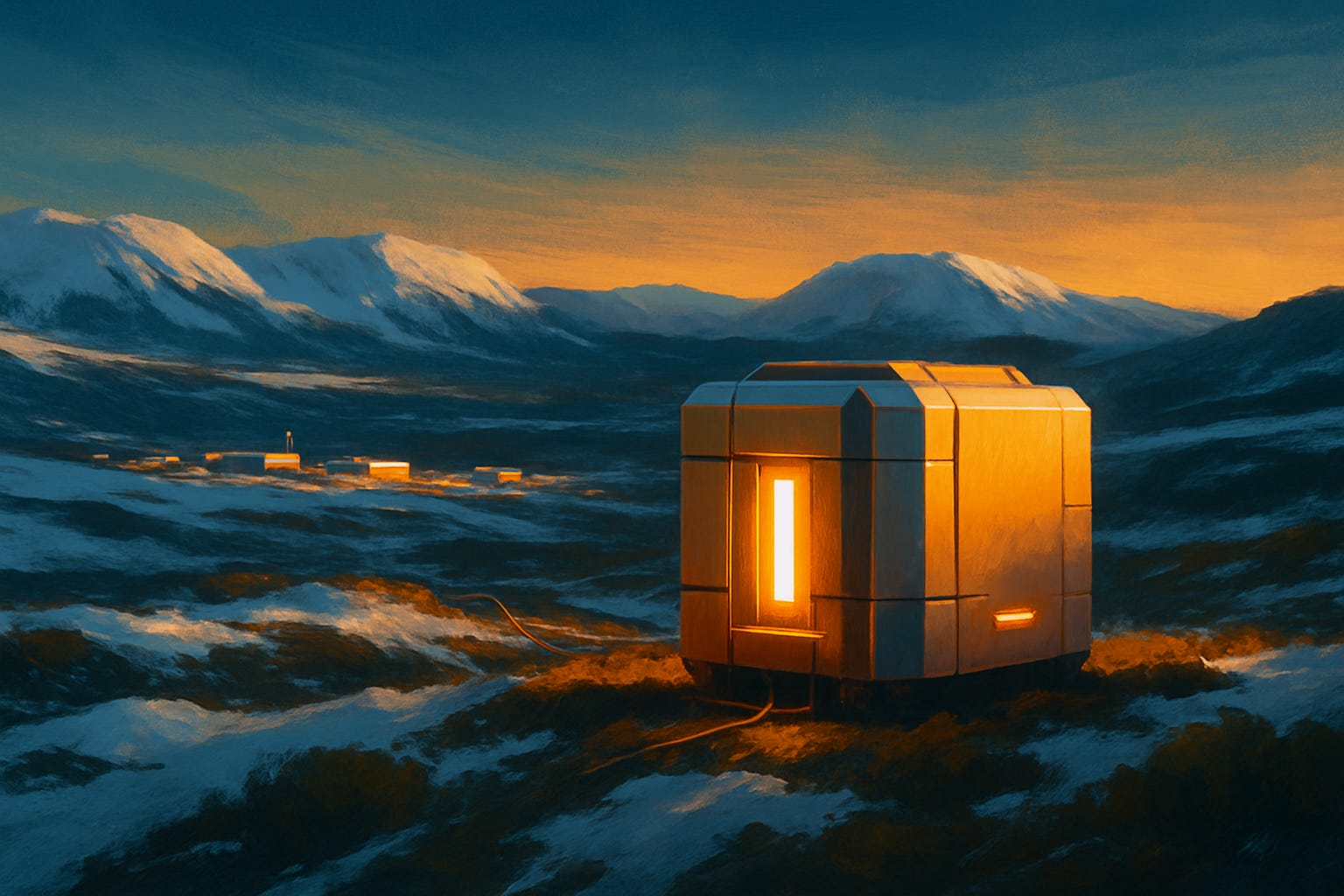
BasicsGridEielson Air Force Base burns through as much as 800 tons of coal a day just to keep the lights on in interior Alaska. That single fact explains why the Pentagon, a handful of Canadian utilities, and a growing list of nuclear startups have all landed on the same idea at roughly the same time: if you can shrink a reactor down to the size of a shipping container, you can solve an energy problem that solar panels and diesel trucks never really could. ❄️ Remote bases and remote communities share the same headache. They sit at the end of a fuel supply chain that’s expensive, vulnerable, and occasionally just doesn’t show up. Here are five concrete ways small modular reactors and their smaller cousins, microreactors, are being aimed at that problem right now.
Fixed nuclear batteries at forward operating bases
Oklo is building the clearest example of this model at Eielson Air Force Base, where the Defense Logistics Agency reissued a Notice of Intent to Award in June 2025 after a 2023 pause tied to acquisition rule questions. Under the deal, Oklo would design, build, own, and operate an Aurora powerhouse delivering up to 5 MWe of electricity plus heat under a 30-year, fixed-price power purchase agreement, supplementing (not replacing, at least at first) the base’s aging coal plant. 🔋 The Aurora is a liquid sodium-cooled fast reactor descended from the old Experimental Breeder Reactor-II, fueled by recycled HALEU. The Air Force has been explicit about why Eielson matters as a template: World Nuclear News reported that officials see the pilot shaping how the Pentagon powers Arctic infrastructure more broadly. Worth noting: this timeline has already slipped once, and first-of-a-kind reactor projects rarely arrive exactly on schedule, so treat any 2027 completion date with a healthy dose of skepticism.
Reactor: Oklo Aurora, liquid metal-cooled fast reactor
Capacity: up to 5 MWe plus heat
Structure: 30-year fixed-price PPA, commercially owned and operated
Regulator: U.S. Nuclear Regulatory Commission
Would you trust a startup that’s never operated a commercial reactor to keep your base’s power on through an Arctic winter? The Air Force apparently would, twice over.
The Army’s fleet strategy for stateside bases
This is the biggest bet on the table so far. The Army’s Janus Program committed up to $2.2 billion across five vendors and five installations on August 26, and it’s explicitly designed as a fleet play, not a one-off demo. 🛡️ Antares Nuclear got Fort Bragg, North Carolina, with its 100 kWe-to-1 MWe R1 reactor deployed in three-unit clusters. BWXT Advanced Technologies landed Fort Campbell, Kentucky, targeting a 20 MWe version of its BANR design with construction starting in late 2028. General Atomics Electromagnetic Systems took Fort Hood, Texas. Westinghouse Government Services got Fort Drum, New York. And Radiant Industries disclosed the largest single commitment, up to $750 million to deploy 15 factory-built, 1 MWe Kaleidos microreactors by 2030, starting with a three-unit installation at Fort Benning, Georgia.
The Army says it eventually wants more than 20 reactors running across installations, with a September 30, 2028 deadline for the first unit to go live. As Army.mil detailed in its announcement, the goal is baseload power that doesn’t depend on a commercial grid a hostile actor could target. 🚀
Reactors you can ship in a box, for the places with no grid at all
Fixed-site bases are one thing. Project Pele, launched by the Pentagon’s Strategic Capabilities Office back in 2020, tackles the harder problem: powering forward or austere locations that don’t have infrastructure to plug into in the first place. BWXT won a $300 million contract in June 2022 to build a transportable, high-temperature gas-cooled reactor generating 1 to 5 MWe, fueled with TRISO particles and small enough to move in standard 20-foot shipping containers. It’s now being assembled and tested at Idaho National Laboratory’s Critical Infrastructure Test Range Complex, and the Department of Energy has said it could become one of the first advanced reactors to operate in the U.S. as early as this year.
Design: high-temperature gas-cooled reactor, TRISO fuel
Portability: fits inside 20-foot shipping containers, plane-transportable
Output: 1 to 5 MWe, “always-on” without refueling for years
Testing site: Idaho National Laboratory
The strategic logic is blunt: a mobile reactor means a forward base doesn’t need a fuel convoy at all, which is exactly the kind of vulnerability commanders have been trying to eliminate for decades. 📦
Retiring the diesel generator in the Canadian north
Head north of the border and the use case flips from military to humanitarian and economic. Canada’s remote communities typically need around 5 MWe each, while remote mines need 15 to 45 MWe, and almost all of that currently runs on trucked-in diesel. 🇨🇦 ARC Clean Energy, working through Global First Power with Ontario Power Generation and USNC, has been demonstrating a 5 MWe gas-cooled Micro Modular Reactor at Chalk River, Ontario, aiming for a 2026 start, though I’d flag that timeline as one to watch rather than bank on. Prodigy Clean Energy signed a memorandum of understanding with Des Nëdhé Group, an Indigenous economic development corporation, to explore shipyard-built Transportable Nuclear Power Plants outfitted with Westinghouse’s eVinci microreactor, a 5 MWe, 13 MWth unit designed to run roughly eight years without refueling. Meanwhile the Saskatchewan Research Council is backing its own eVinci pilot with CAD 80 million in provincial funding, targeting 2029.
Ottawa’s national nuclear strategy leans into this pattern deliberately, calling for a Canadian-designed microreactor finalized by 2035 and deployed in a remote community by the late 2030s, with the Canadian Nuclear Safety Commission handling licensing start to finish. The Pembina Institute has documented that clean energy projects, mostly renewables so far, have already displaced 140 million litres of diesel in remote Canada. Nuclear is aiming at what’s left of that gap, and Indigenous ownership stakes are shaping up to be a defining feature of how these projects actually get built, not an afterthought bolted on for optics.
The regulatory unlock making all of this possible
None of the above works at scale without a licensing process built for it, and the NRC just rewrote its rulebook twice in one year. Part 53, a technology-inclusive framework for advanced reactors, took effect April 29, 2026. Then on April 24, 2026, the NRC proposed Part 57 specifically for microreactors of roughly 100 MWe or smaller, allowing fleet-wide approval of identical reactor designs, fuel loading at the manufacturing facility, and even general licenses to construct parts of a facility before every detail is finalized. NRC Chairman Ho Nieh put it plainly: “They’re small machines, they’re simple machines.” Comments on Part 57 closed June 15, 2026, and the Federal Register notice lays out a process meant to issue operator licenses within six months to a year, a fraction of the time traditional reactors have taken.
This regulatory shift is really the connective tissue between everything above: it’s why Radiant can promise 15 units by 2030, why the NRC can even entertain fleet licensing for the Army’s five-base rollout, and why Canadian regulators are borrowing from the same playbook. Every project, deal, company, and regulatory event we cover is logged, verified, and searchable in SMRbrief Pro, which is genuinely the fastest way to track which of these forty-plus company-site pairings is actually hitting its dates versus which one is quietly slipping.
None of these five paths is a sure thing yet. Reactor projects have a long, unglamorous history of missing their first deadline, and every one of these programs is still short of commercial operation. But the direction is unmistakable: the places furthest from a power grid, whether that’s a forward operating base or a fly-in Cree community, are turning out to be where nuclear’s smallest machines get their first real test. Which of these five deployments do you think crosses the finish line first?